 檔案1
檔案1
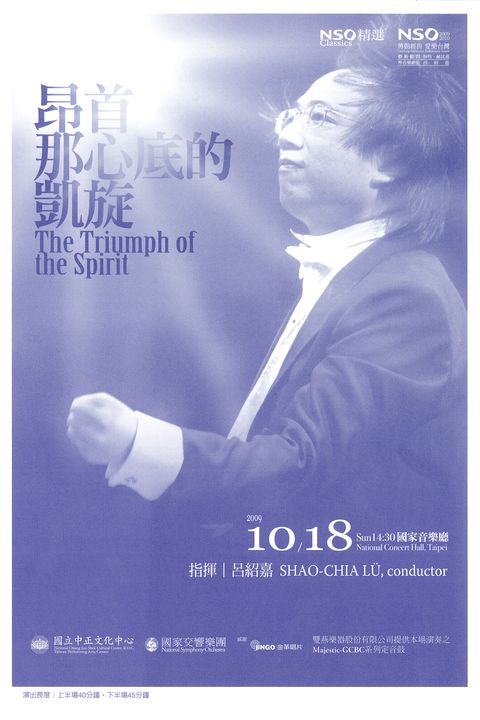
NSO精選-昂首那心底的凱旋
The Triumph of the Spirit
基本資料
2009-10-18
2009/10/18
馮威廉斯:塔利斯主題幻想曲 馮威廉斯 ( Ralph Vaughan Williams, 1872-1958 ) 為二十世紀前半葉最著名的英國作曲家,他為歐洲的傳統音樂,注入濃厚的英國傳統,並再現中世紀與文藝復興時期的輝煌。《塔利斯主題幻想曲》的創作,得自馮威廉斯在編輯讚美詩集時,所接觸到文藝復興時期的英國作曲家塔利斯 ( Thomas Tallis,ca‧1505-1585 ) 的作品《大主教派克的詩篇集》 ( Archbshop Parker's Psalter,1567 ) 。他將其中一首四聲部讚美詩的旋律融入創作於1910年的《塔利斯主題幻想曲》, 1919年完成最後修訂。《塔利斯主題幻想曲》的編制是由兩個弦樂團再加上弦樂四重奏,其中第二個弦樂團較小,由九位組成,造成合唱團對唱式的風格。罕見的調式旋律,不僅使作曲家在和聲的運用上更為自由,亦使古代與現代的風格並置。 由五個廣泛具空間感的和絃開場,接著由低音弦樂以撥弦奏出冥想式的主題片段,中間音域的樂器以弓奏回應。在高音樂器以顫音演奏的伴隨下,塔利斯主題由中提琴與大提琴緩緩奏出,再重新配置由全體重複一次主題。在主題呈現之後,兩個樂團相互對答塔利斯主題的片段,這不僅是簡短的發展段落,也是獨奏的弦樂四重奏的引導;而精湛的對位法展現馮威廉斯對於弦樂的偏好。當時詩狂想式的沈思增強,曖昧不明的印象主義和聲混合調式引導至令人印象深刻的頂點,兩個樂團像是釋放了所有的力量。弦樂四重奏在塔利斯主題上閃耀光輝地帶領至最後。 法雅‧《三角帽》組曲 二十世紀前半活躍於法國的西班牙作曲家法雅 ( Maunel de Fall a,1876-1946 ) ,第一次世界大戰結束後,應當時俄羅斯芭蕾舞團戴亞吉列夫 ( Sergei Pavlovich Diaghilev,1872-1929 ) 之邀而創作芭蕾舞劇《三角帽》,由畢卡索 ( Pablo Ruiz Picasso, 1881-1973 ) 負責布景和視覺設計,在倫敦首演深獲好評。這部舞劇取材自西班牙文豪阿拉康 ( Pedro Antonio de Alarcon, 1833-1891 ) 的作品《三角帽》。這是關於西班牙南部安達盧西亞 ( Andalusia ) 的民間故事,描述官員覬覦磨坊主人貌美之妻的醜態,劇名「三角帽」就是指官員所戴的官帽。法雅擷取芭蕾舞劇中的主要部分改編為二組組曲。 《三角帽》中採用新穎獨特的配器,充滿了西班牙二音樂的熱情與活力。像是在調情戲譜和種種惡作劇中,法雅把西班牙民間音樂中的安達盧西亞風光和以銅管與擊樂的特殊樂隊效果調和,配器生動而豐富,而低音管運用在頭戴三角帽的官員身上,顯得饒富生趣。 第一號組曲以定音鼓和小號帶出序奏,接著進入充滿焦躁氣氛、西班牙風的節奏,並預示結局。以方果舞曲 ( Fandango ) 節奏為主的磨坊主人妻子之舞,帶有緊湊的節奏、飛騰的弦樂旋律,並以木管、銅管與擊樂支撐音色的變化。低音管的滑稽獨奏代表官員、弦樂演奏恬靜優美的旋律來代表磨坊主人妻子。按著磨坊主人妻子在葡萄園戲弄官員,並與言歸於好的磨坊主人跳著之前的方當果舞曲。 第二號組曲以鄰居們跳著賽奎迪拉舞曲 ( Segllidillas ) 開始,弦樂負責大部分旋律並穿插木管與小號。在法國號的獨奏聲響下帶出英國管,開始磨坊主人的舞蹈,此為屬於男性的法魯卡舞曲 ( Farruca ) 。最後之舞屬於霍塔舞曲 ( Jota ) 。法雅將這些舞曲的旋律與節奏的片段分散在芭蕾舞劇全曲中。最後三角帽被踩扁,磨坊主夫婦終於誤會冰釋,和好如初。 蕭斯塔可維奇 :第五號交響曲 蕭斯塔可維奇 ( Dmitri Shostakovich,1906-1975 ) 為二十世紀中期最為道地的俄國作曲家。 1919年進入現今的聖彼得堡音樂院就讀,而他的第一號交響曲即為1925年的畢業作品,這部作品受到熱烈的迴響,使他一舉成名。1934年的歌劇《馬克白夫人》 ( Lady Macbeth of Mtzensk ) 在首演時,讚譽聲不斷,但在當時執政的史達林於1936年欣賞之後,卻受到嚴厲的批判,從此銷聲匿跡,直至 1963年更換劇名後,才重新上演。在當時的環境之下,蕭斯塔可維奇轉向古典與浪漫時期的傳統曲式與風格,並在蘇聯政府下取得平衡點。 在蕭斯塔可維奇的十五首交響曲中,最受到重視與喜愛的莫過於創作於 1937年的第五號交響曲,被譽為「一位蘇聯藝術家對於公正的批評所作的實際且富有創造性的回應」更被形容為「終樂章解決了前面幾個樂章悲劇性的緊張與衝擊,迎來樂觀和生活的愉悅」終於重獲蘇聯政府的肯定。但這首交響曲具有明朗的結構、優雅的旋律與宏偉的氣勢,才是真正使它成為經典之作的原因。 樂曲奇特的以弦樂器上的卡農開始,帶有法國序曲的附點節奏,而這也是整個樂章的主要動機。這種慷慨激昂的情緒偶而被抒情的旋律打斷。帶著怪誕舞曲風格的第二樂章,具嘲諷意味,銅管段落為主要特色。接著緩板的第三樂章,聖歌式的主題顯露出真摯的音樂情感。終樂章充滿光榮、勝利的情緒,也引發許多爭議:有些評論家認為這是政治壓力下所作的讓步,但另一方則認為這或許是帶有反諷意味的。
VAUGHAN WILLIAMS: Fantasia on a Theme by Tallis Ralph Vaughan Williams (1872-1958) was the most celebrated English composer in the first half of the 20th century. He infused the English tradition to the traditional European music and re-created the glory of the medieval rimes and the Renaissance. Fantasia on a Theme by Tallis was an inspiration from Archbishop Parker's Psalter in 1567 by a Renaissance English composer Thomas Tallis (ca.1505 -1585) when Vaughan Williams edited his hymn. He took the melody of a four- part psalm into his Fantasia on a Theme by Tallis in 1910 and completed revising it in 1919. The composition is scored for two string orchestras and a solo string quartet. One of the orchestras has only nine players and functions as a “distant” choir. The peculiar modal qualities of the tune not only allowed the composer considerable harmonic freedom but also made possible the simultaneous sense of the ancient and the modern. The mllsic is opened by five widely spaced chords and a few bars in which the theme is fragmentarily mused upon by pizzicato basses and swaying middle strings. Tallis' hymn tune is stated in its original harmony by violas and celli with tremolando accompaniment by the high strings, and is then repeated in a new setting. After the presentation of the theme, fragments of the theme in the first orchestra are answered by the second This serves not only as a brief development section but also introduces the solo string quartet, whose masterly counterpoint demonstrates Vaughan Williams' affinity for stringed instruments. As the rhapsodic meditation increases in intensity, vaguely Impressionistic harmonies mingle with the modal, leading to an impressive climax in which the two orchestras are unleashed in their full power. The string quartet leads a final, luminolls mllsing on Talls’tune. FALLA: The Three-Cornered Hat Suite Mallncl de Falla (1876-1946), a Spanish com poser who was active in France for the first half in the 20th century, was commissioned by the founder of the Ballets Russes, Sergei Pavlovich Diaghilev (1872一1929), to write the ballet The Three-Cornered Hat after the First World War. Its premiere in London with sets designed by Pablo Picasso was a great success. The story of the ballet is based on the well-known novel El Sombrero de Tres Picos by Spanish writer Pedro Antonio de Alarcon (1833-1891). The novel, inspired by a folktale in Andalusia in soothe Spain, is about a magistrate who has become infatuated with a miller's beautiful wife and his attempts to seduce her. The name The Three-Cornered Hat refers to the hat worn by the magistrate. Falla took the major part of the ballet and adapted it into two suites. The composition uses fresh and unique instrumentation, filled with the passion and vitality of Spanish music. For scenes of l1irtation and prank, Falla employed brass and percussion to express the Andalusian scenery. The bassoon, representing the tricorn-wearing magistrate, creates an interesting effect. The first part opens with timpani and trumpets and is followed by an anxious, Spanish rhythm, indicating the ending. The miller's wife dances a fandango where soaring string, woodwind, brass and percussion support the change of the timbre. The ludicrous solo of the bassoon represents the magistrate while the elegant melody of the strings represents the miller's wife. Then the wife plays a trick on the magistrate in the vineyard and then she dances the fandango with his husband, who made up a quarrel with her. The second part begins with the neighbors dancing seguidillas in which the strings play the major role , supported by the woodwind and the trumpets. With the music of the English horn, ushered in by the solo of the French horn, the miller gives his own driven farruca. The last dance of the neighbors is a jota. Falla dispersed the fragments of the dance melodies to the whole ballet. Finally, the tricorn is stepped on by the crowd and the miller couple gets back together with their misunderstanding resolved. SHOSTAKOVICH: Symphony No. 5 in D minor, Op.47 Dmitri Shostakovich (1906-1975) was one of the most celebrated Russian composers of the mid 20th century. In 1919, he was allowed to enter the Petrograd Conservatory. His first symphony is his graduation work in 1925, whose popularity brought him instant fame. The premiere of his 1934 opera Lady Macbeth of Mtzensk received much acclaim. It was, however, severely criticized and then disappeared due to the instigation of Stalin in 1936. It wasn't restaged unil 1963 when a new name was given to the opera. Under the then circumstances, Shostakovich turned to the traditional model and style of the C1assical and Romaic periods, and stroke a balance with the political c1imate of the Soviet government. His fifth symphony in 1937 is the most valued and appreciated among a11 his 15 symphonies. An unknown commentator dubbed the symphony“the creative reply of a Soviet artist to justified criticism.” In addition,“the finale resolved the tragic nervousness and impact of the previous movements and brought in an enormous optimistic lift.“ This symphony finally received the recognition of the Soviet government. However, the success of this composition actually owes to its clear structure, e1egant melody and grand momentum. The symphony opens with a canon in the strings, a sharply-dotted rhythm of the French overture that forms the motif for the entire movement. The impassioned mood is occasionally interrupted by a lyrical melody. The second movement is a grotesque dance which can’t help but mock itself; the brass section is featured prominently. The choral theme of the following Largo is a sincere and personal outpouring of musical emotion. The concluding movement teems with glorious and victory emotions but also evokes much debate: some critics consider it a concession to political pressure, while others have made note of its possible irony.
馮威廉斯:塔利斯主題幻想曲
法雅:《三角帽》組曲
蕭斯塔可維奇:第五號交響曲
VAUGHAN WILLlAMS:Fantasia on a Theme by Tallis
FALLA:The Three-Cornered Hat Suite
SHOSTAKOVICH: Symphony No. 5 in D minor, Op.47
典藏單位:國家兩廳院,實體文物請至兩廳院表演藝術圖書館申請觀看。
媒體類型:紙本及電子檔

評分
 電話:02-3393-9798 ︳傳真:02-3393-9798 ︳地址:100011 臺北市中山南路 21-1 號
Copyright ©國家表演藝術中心數位典藏系統 版權所有 All rights reserved.
電話:02-3393-9798 ︳傳真:02-3393-9798 ︳地址:100011 臺北市中山南路 21-1 號
Copyright ©國家表演藝術中心數位典藏系統 版權所有 All rights reserved.