 檔案1
檔案1
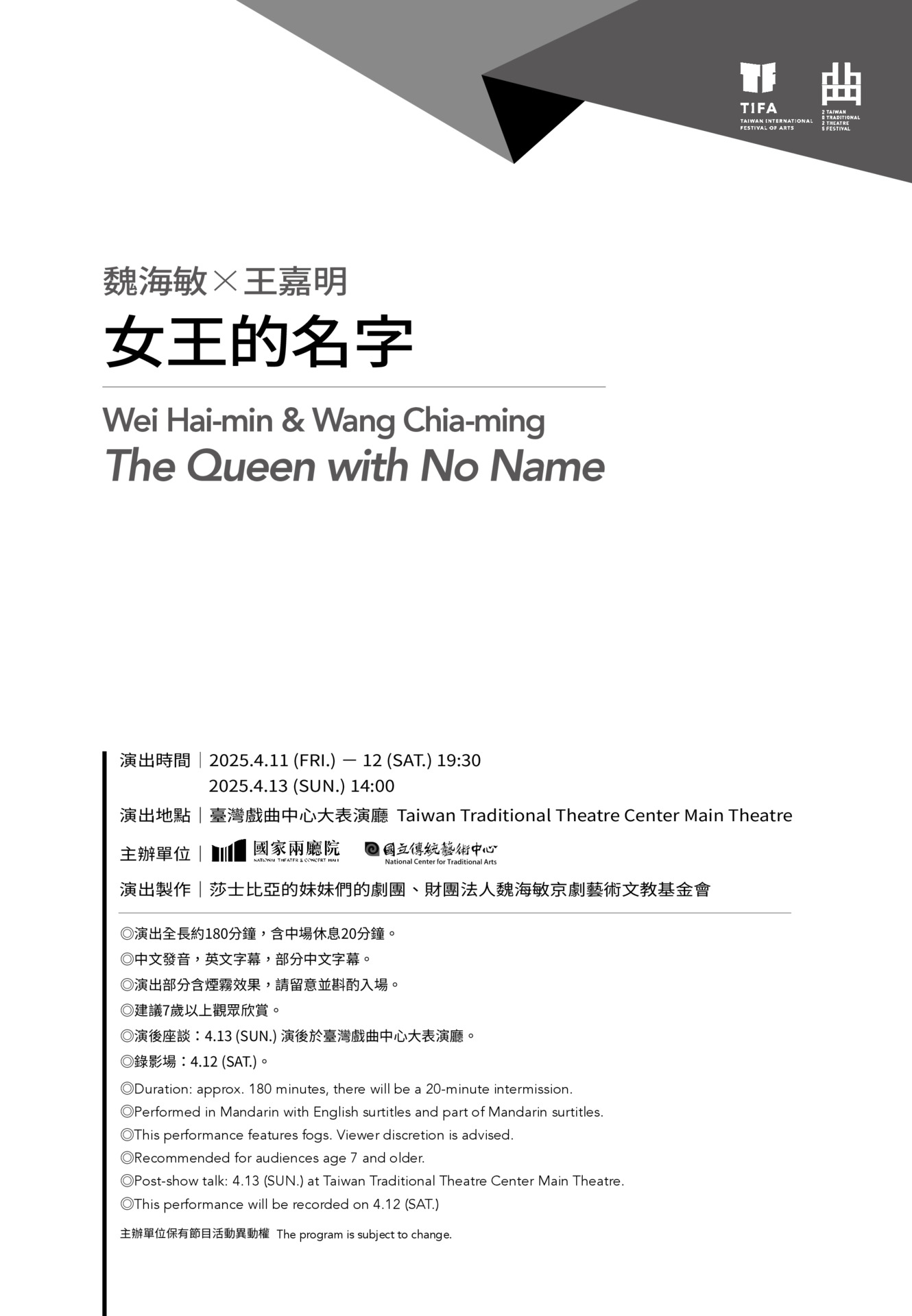
2025TIFA✕TTTF 魏海敏✕王嘉明《女王的名字》
WEI Hai-Min & WANG Chia-Ming: The Queen with No Name
基本資料
2025-04-11
2025/04/11 07:30
2025/04/12 07:30
2025/04/13 02:00
藝術總監的話
魏海敏
「戲劇的本質在真心,戲曲的本源在美心,生命珍寶乃慈悲心,生活的珍寶乃善心。」我僅以這四心祝福曾出現在我舞臺生涯中的后妃們。我衷心希望妳們都能在最好的機緣中做最好的自己,即使在歷史上常常「沒有名字」。
慈禧太后正是沒有名字的女王。
25 歲前的慈禧活得還算開心,自從咸豐死後辛酉政變,她和慈安太后一起垂簾聽政,到光緒的戊戌政變、義和團起義、西安逃難 ⋯⋯,每一件都是牽一髮動全身的大事,要如何演繹?
王嘉明真不愧為鬼才導演,他從慈禧西安逃難開展,旅途中女王不斷痛思苦想:自 己為何會落得如此難堪的境地,我的王朝怎麼了?一段段回憶過去的種種景⋯⋯,我真的錯了嗎?王朝的政策又豈是我一個人能決定的,該如何扭轉局勢、才能富強我朝!
正是她對新世紀的好奇、探索、嘗試,她才是開啟王朝現代化的那個皇太后,也是沒有名字的統治者。
《女王的名字》在 2025 年台灣國際藝術節 TIFA、臺灣戲曲藝術節 TTTF 隆重登場,特別要感謝國家兩廳院、國立傳統藝術中心不斷為臺灣的藝術創作土壤注入養分與生命力。
TIFA, A Flourishing Arts Banquet!
For each TIFA, we look forward to presenting works we believe are must-sees and artists we think deserve more attention via this platform that reflects both the world and Taiwan.
After the pandemic, artists from Taiwan and around the world are in a crouched position, preparing to take a leap. With unwavering attitudes, they respond to the world by challenging boundaries and limitations via their artistic skills and perspective. A total of 118 outstanding performances by 18 performing artists and art groups from 11 countries demonstrate this platform's unique landscapes of diversity and inclusivity. Together, we will experience classic reversals of imagination, extraordinary perspective, and subversive works that cross eras and styles. We will journey through adventures that challenge limitations, explore life and death through immersive technology, and witness long-awaited performances by renowned maestros.
Last but not least, a series of peripheral events have been planned for TIFA, with the expectation of countless possibilities for the public to experience the arts. Perhaps, TIFA can be likened to a garden with flowers in bloom, into which you are welcome to enter and search for your own way to participate in the arts based on your preferred attitude and perspective.
Please join us for this flourishing arts banquet!
Message from Artistic Director
by Wei Hai-min
“The essence of drama is a true heart, the traditional opera originates from a beautiful heart, the treasure in our being is a merciful heart, and the gem of our lives is a kind heart.” With these four hearts, I sincerely extend my heartwarming wishes to all the empresses and concubines, who have accompanied me in my stage career. It is my sincere hope that you are all able to live the best of your own lives, even if you are often “with no name” in history.
Empress Dowager Cixi is exactly a queen with no name.
Before the age of 25, Cixi had a pretty lighthearted life. After Emperor Xianfeng passed away, one thing led to another...from Xinyou Coup, Empress Dowagers Cixi and Ci'an ruling behind the curtains, Emperor Guangxu’s Wuxu Coup, the Boxer Rebellion, and then to her escape to Xi’an... each of these incidents is a major event that could possibly change the whole history with one slightest move. How should we interpret them?
Wang Chia-ming really lives up to his reputation as a genius director. He begins with Cixi's escape to Xi'an. During the journey, she constantly recounted the past in agony: Why would she degenerate into such a downfall? What happened to her empire? Various scenes from the memories passed through her mind one after another ... What has she done wrong? How could she possibly be responsible for all the policies of the entire empire? What should she do to turn things around and make her empire wealthy and strong again?
It is exactly the Empress Dowager's curiosity for, exploration of, and tries at the new century that initiated the modernization of the empire. She is genuinely the ruler with no name.
The Queen with No Name
is to take the stage in the 2025 Taiwan International Festival of Arts and Taiwan Traditional Theatre Festival. I would like to express my special appreciation to the National Theater and Concert Hall and the National Center for Traditional Arts for constantly infusing nutrition and vitality to the soil of artistic creation in Taiwan.
Message from Director
by Wang Chia-ming
How should we present a historical figure in one night?
Should we adopt a perspective that subverts historical judgment? Or maybe an evaluation or a point of view? Perhaps, we just need to tell a nice story, but where should we begin? Should we give it a tearjerking ending? There were so many people coming and going around the person, and they jointly went through so many incidents.
Who should we select? How to make audience know these people? Different incidents generated different versions of the story. How should we choose? What does the person have to do with us? “Truth,” “fact,” “history,” “story,” “morality,” “theater,” and “audience” ... these extremely simple terms were buzzing all around us ... buzzing around us for months ... buzzing like flies ... buzzing in our brains. Sometimes, they even joined hands to form a sentence to attack us. For example, “Is history a brainwashing moral story in the name of truth?” “Is the process of building facts in theater a way to erode the truth?” “Is it possible that we meant to find a story of self-identity as a therapy but in turn make history, an old man with dementia, take a change for the worse?” If I really want to tell the meaning of this work within a few sentences, the only answer is probably buzzing...
“Cixi” is such a huge hole. However, I would like to thank Ms. Wei for dragging me down into it (and I also drag a few people along with me) so that I have the chance to face such a complicated, inextricable, difficult and yet buzzing life.
Synopsis
On the eastward train heading for home, the Queen looked at the seemingly endless sceneries of mountains and rivers outside the windows and recalled the moment when she resolutely made the decision to wrap up the entire court and escape westward for saving the life of her empire.
From there, the whole life of the Queen is portrayed with episodes and glimpses from her memories: those struggles for power and throne; the breathtaking moments between life and death; the sweet times spent with her husband in the music of their beloved traditional opera as a wife; the fierce arguments and agonizing parting forever with her son as a mother; and the days of wandering from place to place without being able to settle down as a queen.
There were different characters surrounding the Queen. They addressed the Queen with different titles, which corresponded respectively to different memories, thus revealing the varying and colorful faces of the Queen.
Creative Team
Director & Playwright: Wang Chia-ming
Wang Chia-ming is currently the head of Shakespeare's Wild Sisters Group. His creative works feature complicated forms and the integration of experiment and popularity. Through the special designs of performing forms, he works with performers to jointly explore, embrace and deliberate on the possibilities of theater. In 2018, his
Café Lumière
was invited by the Festival Tokyo, and in 2019, his work
Dear Life
was invited by the Festival d'automne à Paris, the first Taiwanese contemporary theater work presented in the festival.
Artistic Director & Performer & Vocal Composer: Wei Hai-min
Wei Hai-min is universally considered to be the preeminent Chinese opera actress and singer in the Sinophone world and has been the leading actress in the creations of Robert Wilson and Ong Keng Sen. Ms. Wei has won numerous awards and accolades, most notably the Plum Blossom Award, the highest honor for traditional Chinese theater in China, the National Literature and Art Achievement Award in Taiwan, the Global Chinese Culture Art Contribution Award, and the Outstanding Asian Artist Prize from the Society of Chinese American Culture and Arts. A household name and cultural ambassador, Ms. Wei is considered to be a national treasure and a major force in revolutionizing Chinese Opera globally.
Wei Hai-min is currently the leading actress of GuoGuang Opera Company and the Contemporary Legend Theatre, and the director of the Wei Hai-min Chinese Opera Foundation. Her notable works include
Mu Guiying Takes Command, The Drunken Concubine, Farewell, My Concubine, Medea, The Kingdom of Desire
and
The Golden Cangue.
Shakespeare's Wild Sisters Group
Founded in the summer of 1995, Shakespeare's Wild Sisters Group owes its name to the fictional character in Virginia Woolf's novel
A Room of One's Own
, meaning to liberate women's talents from the oppression of patriarchy. Limiting itself to no specific issues or conventional aesthetics, SWSG takes materials from all arts inspiring to create original theatrical works. Having been to Hong Kong, Macau, Beijing, Shanghai, Busan, Tokyo, Berlin, Singapore, Kobe, Paris, and New York, SWSG has been invited by various cities and countries to perform, and takes an important role in international city culture and artistic exchange for many years.
Wei Hai-Min Chinese Opera Foundation
Established in June 1995 with the declared purpose of “upholding and sustaining the performance features and spirit of the Mei School,” Wei HaiMin Chinese Opera Foundation works to unfold the contemporary meanings of the Mei School art. Wei employs her artistic brilliance and abundance to coordinate rich government and private resources, reach out to the general public, and promote the development of fine culture. Deeply rooted in its native Taiwan, the Foundation has a global outlook and is keen to pursue crossStrait cultural exchange. The Foundation organizes various events including lectures, demonstrations, performances, and workshops in collaboration with other institutes, and produces and publishes audios and videos of jingju classics. As a carrier of jingju culture, Wei exhibits the traditional theatre's multidimensionality.
Credits
Artistic Director & Lead Performer: Wei Hai-min
Director & Playwright: Wang Chia-ming
Playwright & Lyricist: Chen Chien-hsing
Dramaturg: Yu Fu-kai
Producer: Nitta Yukio
Performer: Wen Yu-hang*, Hsu Yen-ling, Tai Li-wum, Lin Chia-chi, Lu Chia-nan, Liu Yun-hsuan, Andy Chou
Musician: Hsu Chia-ming (Huqin), Chiang Chun (Sheng), dongyi (Double bass), Lin Hsiao-feng (Dizi/Xiao), Wu Yen-hsuan (Guzheng), Chen Yin-chun (Percussion)
Set Design: Huang I-ju
Set Design Assistant: Gao Yun-ju, Chen Liang-ju
Costume Design: Lai Hsuan-wu
Assistant of Costume Design: Lin Yu-ling
Lighting Design: Wang Tien-hung
Music Design: Lin Fang-yi, Blaire Ko
Vocal Composer: Wei Hai-min, Hsu Chia-ming
Soundstage Design: Chen To-fu
Sound Equipment & Sound Technical Team: Fly Sound
Stage Manager: Lin Dai-jung
Assistant of Stage Manager & Prop Manager: Chang Kai-feng
Technical Director: Lee Po-hen
Master Electrician: Lai Ke-chu
Acting Master Electrician: Tsai Cheng-lin
Stage Technician: Li Hong-chan, Hung Hao-yuan, Lin Pei-hao, Lin Zhe-wei, Lu Guan-ling, Hsu Hong-cheng
Lighting Technician: Lin Tzu-han, Wang Hsin-wei, Huang Shao-lun, Lo You-lun, Hsu Pu-chiao
Wardrobe: Lin Yu-ling, Yu I-fang, Tseng Ling-wei, Chang Chia-shan
Lead Performer Makeup: Tsao Jin-feng
Performer Makeup: Chen Mei-hsueh, Wang Pei-wen, Liu Ya-jhen
Director Assistant : Liu Yun-hsuan, Andy Chou
Executive Producer: Lu Lin
Prop Maker: Lin Yen-po
English Surtitle: Ker Nai-yu
Surtitle Execution: Wang Yung-wei
Key Visual Photography: Troy Wang
Key Visual Stylist: Joey Lin
Key Visual Set Design: Chia Chien-ju
Key Visual Headpiece Design: Fan Huai-chih
Key Visual Makeup: Liu Ya-jhen
Key Visual Design: SANYO+SANIN
Trailer: Hsu Lien-chieh
Special Thanks: 國光劇團、飛人集社劇團、好人好事製作' NanaFormosa Percussion Duo、Freedom Beat 自由擊、林裕紘
NTCH Production Team
Project Manager: Kueh Hong-phîng
Marketing Project Manager: Hsieh Che-min
Membership Events Organizer: Kiki Liu
NCFTA Production Team
Project Manager: Dolfin Chen
Marketing Project Manager: Iche Tian
Very appreciate for your feedback! This is an online questionnaire:
Online Questionnaire
《女王的名字》
"The Queen with No Name"
典藏單位:國家兩廳院
媒體類型:電子檔

評分
 電話:02-3393-9798 ︳傳真:02-3393-9798 ︳地址:100011 臺北市中山南路 21-1 號
Copyright ©國家表演藝術中心數位典藏系統 版權所有 All rights reserved.
電話:02-3393-9798 ︳傳真:02-3393-9798 ︳地址:100011 臺北市中山南路 21-1 號
Copyright ©國家表演藝術中心數位典藏系統 版權所有 All rights reserved.