 檔案1
檔案1
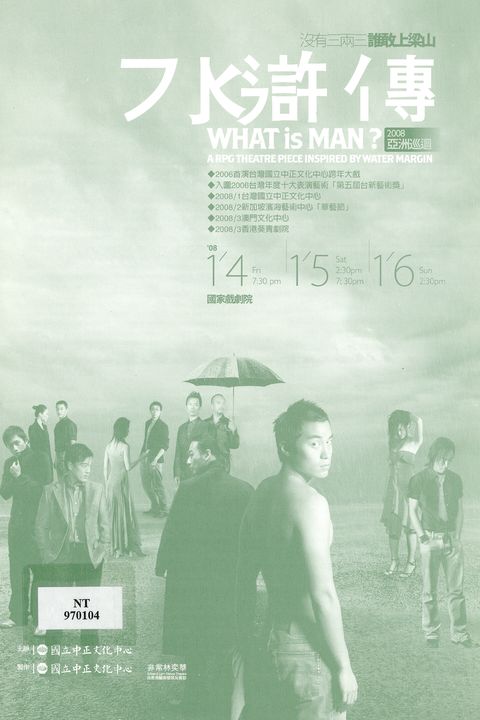
2008亞洲巡迴:水滸傳
What is man?
基本資料
2008-01-04
2008/01/04-2008/01/06
2008/02/12-2008/02/13
2008/03/07
2008/03/21-2008/03/24
水滸人物來到現代的暴力九歌
施耐庵作為《水滸傳》的作者,有別於其他只在家裏一人寫作的作者,而是把流傳散落於男人與男人之間的好漢故事作一次收編整理,成為話本。如果我們視《水滸傳》是借由說書人之口,把文字具體化傳達給觀眾故事的過程,這次 《水滸傳》製作裏的九段心靈獨白,則跨越了傳統說書的框架,把男人的心靈本身,不經別人之口赤裸裸的呈現在觀眾面前。詮釋權回歸到觀眾,使角色的狀態成為閱讀本身。其實觀眾在欣賞這些現代男人的心靈自述,台上演員在沒有隔閡的情況下流露性情,或許重點已經離開了所描述的故事。而是台上台下作了一次心靈交流。
我們從《水滸傳》提煉出九個和男性有關的符號─老虎、賭、人肉、寶刀、酒、賊、智多星、大佬、浪子,再由這九個符號發展出這九段獨白。以這九段獨白作為全劇的基礎,解構男人、水滸、社會三條主題線,也貫穿了男人之痛。
當然,《水滸傳》肯定有更多的符號隱藏當中。但解構出來的九個元素,就好像給九位男演員量身打造的通行證,讓他們不但能進入男人內在的核心,還能自由進出水滸的世界。這種解構的過程有點像羅蘭巴特在《戀人絮語》中如何解構戀人的各種狀態,巴特把戀愛過程當中的各種符號,像零件一樣拆解出,暴露在讀者面前,而羅蘭巴特的分析,只有解構,而沒有再製造的過程。我們這次則企圖利用拆解《水滸傳》所得的符號作為零件,再製組裝,探討什麼是「男人」。
全劇以Audition的情景作為前提和框架,引發觀眾聆聽這九段獨白與RPG情境的動機。
我們希望,整晚的演出,作為一個解構與重新建構男人定義的過程,就某種程度上而言,也可以是一場對男人的心靈治療過程。就像戲中盛鑑所扮演的心理醫師中的一句台詞所言:「我會被這些東西吸引,是因為我在那面鏡子裏看見 了自己。」
─陳銘峰、廖若涵
Contemporary characterization of "The Water Margin"
- Brief on conception of "What is Man?", Min-Fong Chen and Rwo-Han Liao
The author of "The Water Margin" Shi Nai-An differs from other authors in that he compiles legendary folktales of heroes from the spoken word into works of fiction, instead of telling imag- inary stories that may include real people, places, and events.
The nine monologues in "What is Man?" have transcended the traditional framework of story-telling by presenting these men's innermost true selves. The audiences therefore are free to interpret the play since no messages are imposed upon them, making the characterization only the "reading" process of the plot. Under such circumstances where there is no barrier between the cast onstage and the audiences, the main focus drifts away from the storyline, and highlights the spiritual exchange instead.
The nine soliloquies were developed from the nine mascu- line symbols of tragic heroism in the original novel, "The Water Margin"- Tiger, Gambler, Human Flesh, Precious Sword, Wine, Thief, Resourceful Strategist, The Boss, and Wanderer. These soliloquies form the basis of the plot, which revolves around three themes of man, brotherhood and the society. These are issues that are sure to penetrate the heart of the modern man.
Despite there being additional hidden symbols in "The Water Margin", the nine elements allow the audiences to understand brotherhood as well as the innermost cores of these characters. Such analytic process is comparable to the French literary key figure Roland Barthes' "A Lover's Discourse: Fragments" in the way he analyses the unrequited lover's emotional status through- out the novel. The signs that Barthes utilizes in the novel are decoded and taken apart for the readers but not reconstructed towards the end. In contrast, we attempt to reconstruct these symbolisms in "What is Man?" as we explore what makes a man.
The play begins with an audition which serves as the frame- work for the following nine monologues and role-playing game.
We hope the performance will be a process of redefining man, which will also serve as a spiritual therapy. Quoting from the psychologist in the play, "I'm attracted to these things because I can see myself in the mirror."
水滸傳
What is man?
典藏單位:國家兩廳院,實體文物請至兩廳院表演藝術圖書館申請觀看。
媒體類型:紙本及電子檔

評分
 電話:02-3393-9798 ︳傳真:02-3393-9798 ︳地址:100011 臺北市中山南路 21-1 號
Copyright ©國家表演藝術中心數位典藏系統 版權所有 All rights reserved.
電話:02-3393-9798 ︳傳真:02-3393-9798 ︳地址:100011 臺北市中山南路 21-1 號
Copyright ©國家表演藝術中心數位典藏系統 版權所有 All rights reserved.