 檔案1
檔案1
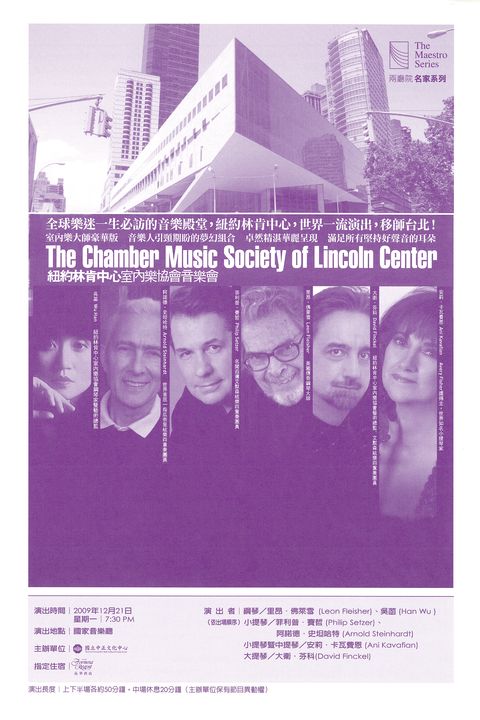
紐約林肯中心室內樂協會音樂會
The Chamber Music Society of Lincoln Center, New York
基本資料
2009-12-21
2009/12/21
舒伯特 :A 大調小提琴奏鳴曲《二重奏》,D574
十九世紀初期的奧國作曲家舒伯特 ( Franz Schubert, 1797-1828 ) ,世人大多只記得寫作藝術歌曲的舒伯特,較少人會談論他在器樂方面的作品,忽略其成長背景對於他創作的影響。舒伯特的父親是一所學校的校長,舒伯特從小不僅是唱詩班的成員 ( 維也納兒童合唱團前身 ) ,也學習鋼琴、小提琴與管風琴,全家幾乎都會樂器,因此他常為家庭聚會創作室內樂。
舒伯特以短短的三十年生命留下上百首藝術歌曲足以道盡他才華洋溢的一生,生前的作品並未受到一般民眾的喜愛,這要歸咎於十九世紀初期歐洲正瀰漫著中產階級興起所形成的布爾喬亞文化,這種安逸、視音樂為生活娛樂,陪襯社交場合氣氛的市民階級,的確沒有很高的藝術素養來理解舒伯特他那與詩結合的藝術音樂。他的音樂只存在他與好友之間,也是音樂史上極為著名的「舒伯特圈」 ( Schubertiade ) ,這也是當時詩人、藝術家、音樂家與愛好藝文人士聚集的圈子,他的作品大部分也是為了朋友聚會時享樂而作,如小提琴奏鳴曲或室內樂等。
舒伯特的所有作品,包括器樂都是以歌唱旋律為出發,樂曲中出奇不意的和聲與變化,更強加作品的戲劇性。雖然舒伯特以藝術歌曲聞名,但是他的器樂作品也是西方音樂的佳作,尤其是室內樂。A 大調的小提琴奏鳴曲創作於1817年,是為他朋友要去會所寫的音樂,風格雅緻,有著豐富、抒情的歌唱性,仍保留了古典時期的餘風,共有四個樂章,甜美、富歌唱性的第一樂章,為A大調,奏鳴曲式,四拍子;輕快的F大調詼諧曲第二樂章,有如狩獵或騎馬的奔騰,溫和旋律性的中段與前後的該諧曲形成節奏與風格上強烈的對比。小行板的第三樂章為 C 大調,節奏強烈急促的第四樂章為A大調,屬於奏鳴曲式。
此曲共有四個樂章:第一樂章由大提琴奏出鬼魅、破碎的和弦開始,引導我們進入怪異、不舒服的音樂風景。從這微弱的開始,音樂依著速度,有規律的漸強,在這首有著交響曲規模的樂曲中,此樂章表現出剛強的特質。當年 Sollertinsky 的姊姊在聽完此曲之後,認為狂亂的第二樂章就像是她弟弟的音樂畫像,剛毅、幽默有著豐富的思考性。緩板的第三樂章,是由鋼琴在低音域奏出八個慢的、憂鬱、陰沈的和絃開始,爾後才由小提琴與大提琴緩緩的奏出一種 悲歎、令人動容、不間斷的旋律。終樂章是作曲家寫過最陰森的音樂,這也是猶太音樂風格首次出現在他的音樂中,這樣的音樂語彙,在他後來的音樂中成為壓迫與受難的象徵。樂章最後,安靜的靜止在巨大的墓穴中。
布拉姆斯:F 小調鋼琴五重奏,作品34
這是德國作曲家布拉姆斯 ( Johannes Brahms, 1833-1897 ) 唯一一首以絃樂四重奏加上鋼琴的五重奏作品。原為布拉姆斯1862年寫給絃樂四重奏與一把大提琴的作品,經過小提琴家兼好友姚阿幸的勸告後,改編為雙鋼琴 ( Op‧34b ) 的版本,但在克拉拉‧舒曼的建議下,才成就了這首精彩的鋼琴五重奏,此版本也於1866年在萊比錫首演之後,快速擴散到各地。
這首五重奏是布拉姆斯旅居於維也納之後的作品,此時期的他重新從古典樂派中挖掘各種可能性,與當時站在浪漫樂派浪潮頂端的白遼士、李斯特等前衛樂派背道而馳,因此引來多次的筆戰。此曲展現作曲家嚴守古典主義的原則,呈現交響曲般豐厚的音響與寬廣,華麗的彩度足與鋼琴協奏曲比擬,結構宏偉、樂器聲部結構緊密。此外他也使用主題變形的技巧,將原有的主題以各種不同的心情與性格出現,使全曲洋溢著青春與熱情的氣息。
此曲共有四個樂章,以上行四度開始的第一樂章,為典型的奏鳴曲式,具有陰沈、遼闊的氛圍,這第一主題的音型是布拉姆斯最喜歡使用。鋼琴奏出以雙音構成的第二主題,這個主題稀奇的轉到升 C 小調,這是將屬音移高半音,主要是降低演奏的難度。發展部的素材主要是來自於第一主題,不斷的擴大變形,加以呈示部的其他素材發展成長大的段落。第二樂章為甜美、混柔的降A大調,風格與結構具有舒伯特的風格。該諧曲的第三樂章為活潑、生動的 C 小調,北國的風格瀰漫整個樂章,中段轉到溫暖、抒情的 C 大調。F 小調第四樂章是附有慢板導奏的奏鳴曲式,這也是布拉姆斯少數在室內樂快板樂章的表現。陰暗、神秘、的導奏,頗有舒曼的風格。進入快板的主題在鋼琴伴奏下,先由大提琴奏出,在小提琴、鋼琴與中提琴依序重複。第二主題由小提琴哀傷的奏出 G 小調的第二主題。之後出現有裝飾音、具有吉普賽風格的樂句,最後進入從容急板的升 C 小調的尾奏。
Schubert: Violin Sonata in A major Duo,D574 When people talk about Franz Schubert (1797-1828), the Austrian composer of the early 19th century, they would probably first think of his lieder when, in fact, his works of instrumental music are also great achievements. It is important not to ignore the inf1uence of his upbringing upon his creative works. Schllbert's father was the principal of a school and Schllbert was a member of a choir (which later became Vienna Boy's Choir) and he learned to play the piano, violin and organ. Almost a11of his family members were musicians and therefore he often created chamber music works for family gatherings. With a life of merely thirty years, Schubert left behind hundreds of lieder songs that proved his talent and artistic creativity. Yet his works were not very popular among the general public, due to the rise of bourgeois culture in the 19th century Europe which regarded music as merely entertainment. People could not understand his artistic music. It was mostly among his friends that his music was appreciated, a small group known as Schubertiade. All of Schubert's works, including instrumental music, are based on melody of songs. The unexpected chords and variations enhanced the dramatic character of his works. This violin sonata in A major was created in 1817, written for a gathering of his friends. It is graceful and elegant, with rich expression and has a character like a song and a trace of classical period style. There are four movements in this work; the first movement is sweet like a song, a sonata form in A major. The second movement is lighter scherzo in F major, the mild melody in the middle forms sharp contrast of both tempo and style to the beginning and the ending scherzo style. The third movement is andante in C major, and the fast, powerful fourth movement is a sonata form in A major. Shostakovich : Piano Trio in E minor, Op. 67 This piano trio was conceptualized in 1943 and completed in 1944, a work by Dimitri Shostakovich (1906-1973) after his seventh and eighth symphonies. It was the turn of World War Two and the Nazis were being defeated everywhere. Yet Schostakovich was not in a mood of victory and peace. When he finished the first movement of this work, he heard of the death of his good friend 1van Sollertinsky. They first met in 1927, and the brilliance, extensive knowledge and humor of Sollertinsky brought inspiration and Support to Schostakovich He said that, “He was my very closest and dearest friend. I am indebted to him for all my growth. To live without him will be unbearably difficult.” And about the same time the truth of the Holocaust was revea1ed, bringing strong shock to Schostakovich. With these impacting events on his mind, he wrote this work. The first movement begins with a ghostly broken chord played by the cello, taking us into a strange and uncomfortable music scene. From this weak beginning, the music grows stronger and features a symphonic character. When Sollertinsky's sister heard this music, she thought that the second movement was very much like a portrait of her brother, determined, humorous, and thoughtful. The third movement starts with eight slow, depressive and shadowy chords by the piano. Then the violin and cello join to play a moving, sad melody without pausing. The last movement is the most haunting music written by Schostakovch, and the first time the Jewish music style appears in his music. Such language of music later became the symbol of persecution. Finally it ends in a great entombing mood. Brahms : Piano Quintet in F Minor, Op. 34 This is the only work of quintet adapted from a string quartet by adding the part of a piano written by Johannes Brahms (1833-1897). Originally written in 1862 as a work for string quartet with a cello, Brahms adapted it for two pianos in accordance with the suggestion of Joseph Joachim. Yet Clara and Schumann gave further suggestions and Brahms finished this great piano quintet. After the premiere in Leipzig in 1866, this version became widely popular. This work was written after Brahms' time in Vienna. During that time, he discovered different possibilities from classical school and was contrary to the trend of romantic school composers like Berlioz and Liszt. After much controversy, this work shows that Brahms followed the classical principle and expresses the rich sound and width of symphony music. The extensive color is comparable to piano concertos and it also features grand structure with closely combined instrument parts. Brahms also used theme variation, showing the theme in different moods and characters, endowing the work with youthful passion. There are four movements, with the first movement a typical sonata form with a shadowy and encompassing atmosphere. The first theme is a favorite of Brahms. Then the piano plays the second theme before it then turns to C sharp minor. The second movement is a sweet and gentle A flat major, with the style and structure like Schubert. The third movement is scherzo with active and lively character in C minor. It turns to C major in the middle which is warmer and expressive. The fourth movement is a sonata form in F minor with a beginning of lento, which is uncommon in Brahms' arrangement of allegro movement in chamber music. A mystical and dark beginning is followed by the theme in allegro played by cello and repeated by violin, piano and viola. The second theme is played by violin in G minor. Then some phrases in Gypsy style leads to the ending in C sharp minor of presto speed.
舒伯特:A大調小提琴奏鳴曲《二重奏》,D574
蕭斯塔可維奇:E小調鋼琴三重奏,作品 67
布拉姆斯:F小調鋼琴五重奏,作品34
F. Schubert:Violin Sonata in A major Duo, D574
D. Shostakovich:Piano Trio in E minor, Op. 67
J. Brahms:Piano Quintet in F minor,Op. 34
典藏單位:國家兩廳院,實體文物請至兩廳院表演藝術圖書館申請觀看。
媒體類型:紙本及電子檔

評分
 電話:02-3393-9798 ︳傳真:02-3393-9798 ︳地址:100011 臺北市中山南路 21-1 號
Copyright ©國家表演藝術中心數位典藏系統 版權所有 All rights reserved.
電話:02-3393-9798 ︳傳真:02-3393-9798 ︳地址:100011 臺北市中山南路 21-1 號
Copyright ©國家表演藝術中心數位典藏系統 版權所有 All rights reserved.