
 檔案1
檔案1
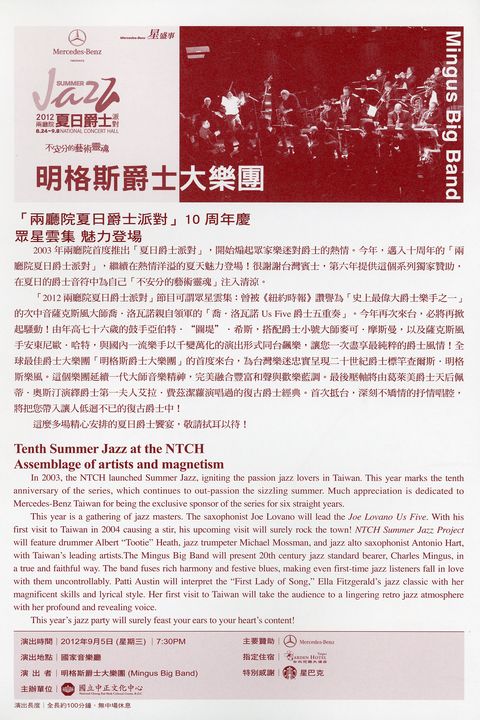
明格斯爵士大樂團
Summer Jazz-Mingus Big Band
基本資料
2012-09-05
2012/09/05
為了紀念一代爵士大師查爾斯‧明格斯(Charles Mingus),由其遺孀成立的明格斯爵士大樂團,成軍超過20年,忠實保留查爾斯‧明格斯DNA,延續大師音樂精神,完美融合豐富和聲與歡樂藍調的演繹,即使是第一次聽爵士樂的觀眾也會不自覺地愛上他們的演出!
明格斯爵士大樂團獲獎不勝枚舉, 2010年專輯更獲葛萊美「最佳爵士專輯」肯定,《華盛頓郵報》讚譽他們為「全球最佳爵士大樂團」,《紐約時報》亦讚譽他們為「爵士史上不可或缺的大樂團」。高手雲集的大樂團本次來台的演出將以三把小號、五把薩克斯風、三把長號、搭配鋼琴、低音貝斯與節奏鼓的十四人大樂團組合,以強烈的節奏激盪出澎湃的大樂團樂風,並以豐富熱情的咆哮,令人愉悅搖擺的即興,向一代大師致敬。
Charles Mingles had been widely recognized as a legendary jazz musician and also known for his rebellious spirit. Throughout his life, Charles fought against oppressive forces and voiced for the weak. This spirit also marks his music style unique and almost impossible to imitate. Since his death in 1979, many musicians formed bands in his name, and this year we have the honor to invite the Mingus Big Band, founded by Mingus's widow, Sue Graham Mingus, to perform at NTCH Summer Jazz Festival.One of Mingus’ most significant works is “Fables of Faubus”, writted in 1959 as a protest to the racial segregation policy by the governor of Arkansas Orval E. Faubus. The song is full of rage in an experimental style, as can be heard from the loud and ironic sound of the trumpet. The lyric challenges the unfairness and is full of cursing words, immediately making it a focus of controversies. Mingus was born in 1922 in Arizona. His mother did not allow him to do anything except religious music, yet Mingus learned to play long trombone and cello while listening to Duke Ellington. He wanted to study classical music yet was barred from the academy because of his skin color, which affected him to have a lifelong attention on the injustice of racial discrimination. As a teenager, Mingus was known as a bassist, with a free-spirited playing style. Subsequently he worked closely with Charlie Parker, bringing strong influences on him in both music career and personal life. In the 50s, Mingus was involved in various incidents of violence and drug, yet he managed to publish a classic album- Pithecanthropus Erectus. The album is considered as a major success. In the 60s, Mingus started to use his music as a mean of protest, bringing issues like racial discrimination and exploitation of female into focus. His album from 1963, The Black Saint and the Sinner Lady, was mostly focusing on the topic of skin colors and gender relations. The album received the highest critics from the Penguin Guide, and was considered as his greatest achievement.
無
典藏單位:國家兩廳院,實體文物請至兩廳院表演藝術圖書館申請觀看。
媒體類型:紙本及電子檔

評分
 電話:02-3393-9798 ︳傳真:02-3393-9798 ︳地址:100011 臺北市中山南路 21-1 號
Copyright ©國家表演藝術中心數位典藏系統 版權所有 All rights reserved.
電話:02-3393-9798 ︳傳真:02-3393-9798 ︳地址:100011 臺北市中山南路 21-1 號
Copyright ©國家表演藝術中心數位典藏系統 版權所有 All rights reserved.