 檔案1
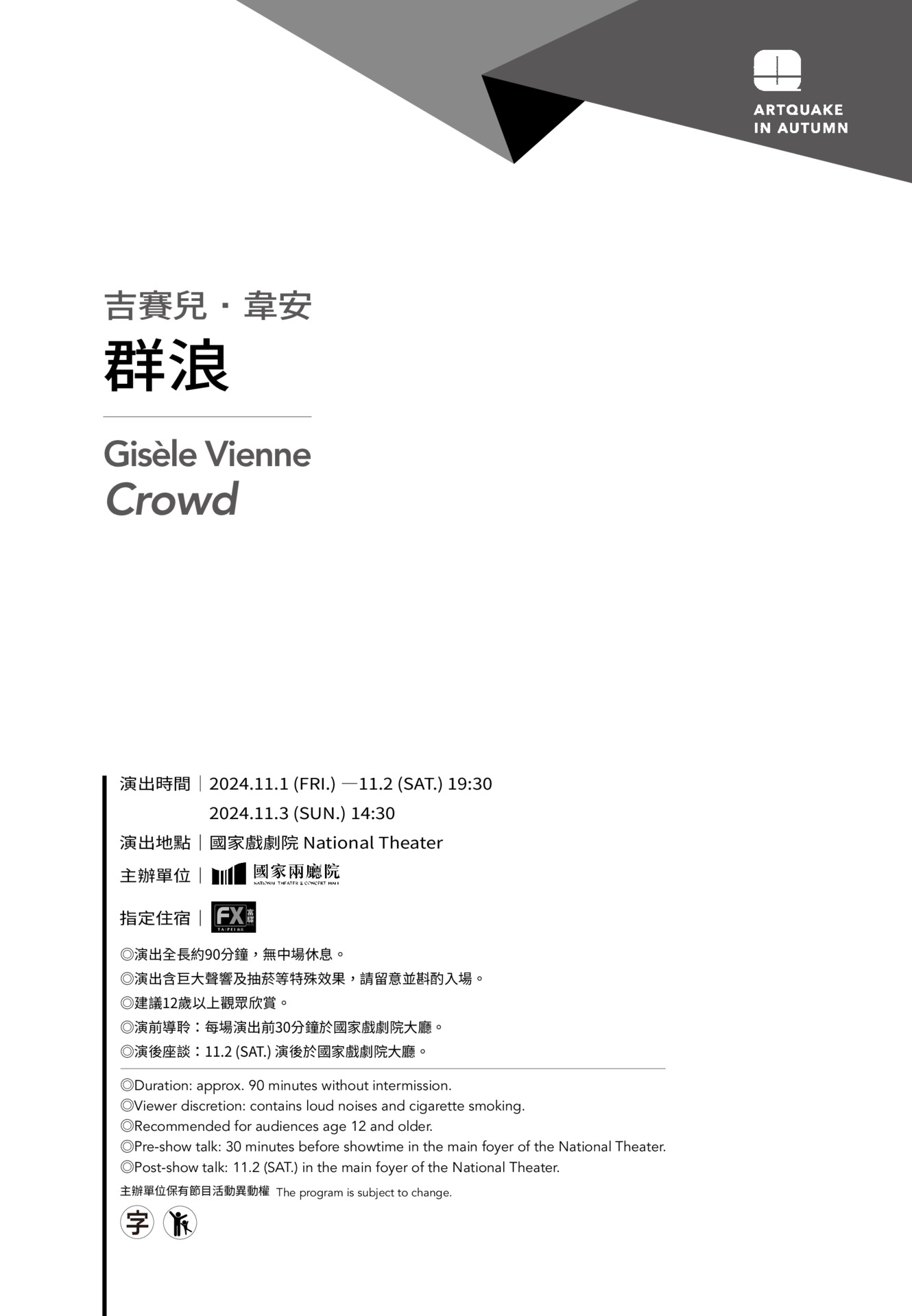
2024秋天藝術節 吉賽兒.韋安《群浪》
Gisèle Vienne: Crowd
基本資料
2024-11-01
2024/11/01 07:30
2024/11/02 07:30
2024/11/03 02:30
看不見的岸
從岸離開,靠岸抵達。岸是此時此刻的現在,也是未知的理想境地,在可能抵達的他方。
人類歷史中,移動是常態,我們總是存在在「之間」。在停留和動身之間、在離岸文化、環境、他人,彼此交疊的軌跡,勾勒出我們存在的形狀。
今年秋天藝術節以「看不見的岸」為題,講述此岸到彼岸的路途中,所經驗的、被抹除的、斷裂的與縫補的一切,及在漂泊之間,抵達和未曾抵達的故事。旅途上的所見所想,改變了踏上旅程的我們,而我們和自己及世界的新關係也由此而生。
吉賽兒.韋安創作訪談
透過《群浪》,您繼續探索奇思妙想的宇宙以及藝術與神聖之間的關係,從一開始這就是您創作的特色。然而,您是否第一次從集體角度來探討這個主題,並且動員這麼多的表演者?
直到《The Pyre》(2013)之前,我的作品無論表演者的人數多寡,主要都是透過孤立的角色,探討私人空間以及疊加的親密感。而在《腹語師的瘋狂集會》(The Ventriloquists Convention)(2015)之後,這是我第二次呈現一個以社會活動及互動為核心的群體,這一群人與《腹語師的瘋狂集會》的群體有很大不同,這是一群年輕人,渴望狂喜,同樣對於 techno 這種音樂類型感興趣,而聚集起來,這次選擇的背景是一場派對,這一群人在舞臺上的安排恰恰可以探討親密感與群體、個人與集體情感之間的關係。
社會學家、人類學家和哲學家都在探討藝術與宗教之間的關係,特別是那些不合時宜表達出的想法及情感,無論是原始的還是當代的、真實的還是潛在的,我從一開始就對這樣的叩問很感興趣。無論是色情、死亡還是暴力,這些問題沒有人可以置身事外,甚至,這些問題所造成的特定經驗對集體有害。
在《群浪》裡,伴隨著對愛的渴望與複雜的需求,時而激昂,時而有濃烈情緒爆發。這些人因為參加一場派對而形成了一個族群,已經準備好去體驗各種強烈的情感,達到一種高度敏感的感官狀態。這部作品的結構和特定行為引發各種儀式,使這一群人亢奮,面對這樣的強烈情感波動,觀眾也能與這部作品建立一種身體與情感上的共鳴。
音樂在這部作品中扮演什麼角色?
電子音樂知識相當淵博的英國作曲家彼得.雷伯格(Peter Rehberg)推薦了許多首樂曲,從他的推薦裡我為《群浪》挑選了部分曲目,雷伯格再仔細處理最終的混音。我發現這次的選曲很有意思,富有貼切歷史意義,包括了對電子舞曲音樂歷史非常重要的專輯,包含來自底特律的音樂家,例如傑夫.米爾斯(Jeff Mills)及其他地下抵抗樂團(Underground Resistance) 的 成 員 創 作,還有德國作曲家曼努埃爾.戈特欽(Manuel Göttsching),我的目標是彙總過去四十年來令人心潮澎湃的重量級音樂。
除了這些貫穿演出的曲目外,還有一首由 KTL(史蒂芬.奧馬利 Stephen O’Malley 和彼得.雷伯格)創作的原創曲,以及彼得.雷伯格的另一首個人作品。
丹尼斯.庫珀的文本扮演什麼角色?您自己曾提到過「潛臺詞」?
這些作品,就像現實世界一樣,由不同層次的文本組成,但文本並非全部。語言不僅僅表現聽得到的部分。在《Jerk》(2008)中, 演員從頭到尾都在講臺詞;而在《I Apologize》(2004)中,類似的問題也出現了,雖然從頭到尾,演員一句話都沒說。丹尼斯.庫珀和我長期合作,從一開始兩人就熱衷於在每個創作裡嘗試重塑文本、語言、敘事的新關係,並探索舞臺創作的新寫作方式。
《群浪》的「潛臺詞」是一個雖然聽不到但部分可理解的文本。在《群浪》中,15 位舞者也分別構成了不同的角色,他們的心理、想像、情感和過去各不相同。當你觀察一場派對時,眼前會上演許多的「故事」;在《群浪》中,庫珀根據與演員合作的成果,發展出了角色的歷史與面貌,進一步提升並影響了作品的創作。這一點讓人聯想到音樂混音的過程,涉及敘事的混合,就像你有十五條不同的音軌,要調整各自的音量,讓作品能在觀眾觀看和體驗作品時,掌握關鍵角色。
您作品中的另一個特徵是以夢境對比現實、真實對比幻想的不同層次分離,創造出時間扭曲感。
《群浪》具有非常豐富的形式潛力。這類作品的核心要素之一在於多重動作風格化的處理及其拼貼。不是去模仿或重新演繹動作,而是由情感和動機引導表演者非常私密的詮釋,這能帶動表演者,使他們對周圍發生的事情更加敏銳。我同樣也會區隔細分,舞者們有時會進入同一種風格的狀態,使用同一種語言,其他時候,則會以不同的動作表達。這樣一來就打造出非常豐富的節奏和音樂脈動,稍稍改變感知,有點像是幻覺或催眠的感覺,但依然富有意義。事實上,這種音樂和編舞的工作法能創造敘事,節奏的操縱引發了相當強烈的時間扭曲感,充滿動能,同時拉長了時間,使人們能夠從近距離觀察角色和情境,並細細剖析他們的行動。不只是相同的律動,還有舞者與音樂及燈光的關係無時不刻都在變化,使各種時間感重疊交織。
本文為大衛.桑松(David Sanson)為 2017 年巴黎秋天藝術節(Festival d’Automne à Paris)所做的專訪
舞作概念、編創及舞臺設計:吉賽兒.韋安 Gisèle Vienne
吉賽兒.韋安是一位法奧混血藝術家、編舞家暨導演。哲學系畢業之後,她進入法國國立高等偶戲藝術學校(Ecole Supérieure Nationale des Arts de la Marionnette)學習偶戲。過去二十年來,她的作品在歐洲、亞洲以及美洲巡演,其中包括《Showroomdummies #1, #2, #3, #4》(2001-2020)、《I Apologize》(2004)、《Kindertotenlieder》(2007)、《Jerk》(2008)、《This is how you will disappear》(2010)、《LAST SPRING: A Prequel》(2011)、《The Pyre》(2013)、與哈勒木偶劇院合作的《腹語師的瘋狂集會》(The Ventriloquists Convention)(2015)、《Crowd》(2017)、《L'Etang》(2021)以及《EXTRA LIFE》(2023),2021 年製作了電影《Jerk》。
吉賽兒.韋安的攝影作品與裝置藝術是各大美術館的常客,其中包括紐約惠特尼美演出音樂 Music List 術館、巴黎龐畢度中心、布宜諾斯艾利斯國家美術館、日內瓦當代藝術中心以及巴黎現代美術館。在 2024/2025 年,將於柏林當代藝術中心 Haus am Waldsee 和喬治.科爾貝美術館推出兩場全新展覽,展覽將於 2024 年柏林藝術週期間開幕。
她曾出版過兩本著作:與丹尼斯.庫珀(Dennis Cooper)、彼得.雷貝格(Peter Rehberg)以及喬納森.卡普德維耶(Jonathan Capdevielle)於 2011 年合著完成《JERK / Through Their Tears》;與丹尼斯.庫珀及皮埃爾.杜爾特(Pierre Dourthe)於 2012 年合著《40 PORTRAITS 2003-2008》。與艾斯特爾.哈納尼亞(Estelle Hanania)和艾爾莎.多林(Elsa Dorlin)合作的攝影新書,將於 2024 年秋季由 Spector Books 出版。
韋安的創作推動了多本著作出版,演出的配樂也發行數張專輯。
演出音樂
依演出播放順序排列:
Underground Resistance: The Illuminator (
Underground Resistance
, 1995)
KTL: Lampshade (
exclusive
, 2017)
Vapour Space: Gravitational Arch Of 10 (
Plus 8
, 1993)
DJ Rolando: Vibrations mix (
Underground Resistance
, 2002)
- Underground Resistance: Sweat Electric (
Somewhere In Detroit
, 1994)
- Underground Resistance: Twista (
Underground Resistance
, 1993)
- Drexciya: Wavejumper (
Underground Resistance
, 1995)
- The Martian: The Intruder (
Red Planet
, 1992)
- Underground Resistance: Code Red (
Underground Resistance
, 1993)
- Underground Resistance: Lunar Rhythms (
Somewhere In Detroit
, 1995)
- Underground Resistance: Hi-Tech Funk (
Underground Resistance
,1997)
Choice: Acid Eiffel (
Fragile Records
, 1992)
Jeff Mills: Phase 4 (
Tresor/Axis
, 1992)
Peter Rehberg: Furgen Matrix/Telegene (
exclusive
, 2017)
Manuel Göttsching: E2-E4 (
Inteam
, 1984)
Sun Electric: Sarotti (
R&S Records
, 1993)
Global Communication: 14 31 (Ob-selon Mi-Nos) (
Evolution
, 1994)
演職人員一覽表
舞作概念、編創及舞臺設計:吉賽兒.韋安 Gisèle Vienne
共同協助:Anja Röttgerkamp、Nuria Guiu Sagarra
燈光設計:Patrick Riou
戲劇構作:Gisèle Vienne
角色發展文本:演出者與 Dennis Cooper、Gisèle Vienne
共同合作音樂:選自 Underground Resistance、KTL、Vapour Space、DJ Rolando、Drexciya、The Martian、Choice、Jeff Mills、Peter Rehberg、Manuel Göttsching、Sun Electric、Global Communication
音樂編輯及選曲:Peter Rehberg、Gisèle Vienne
音場設計及指導:Stephen O'Malley
音響工程:Adrien Michel
演出者:Philip Berlin、Morgane Bonis、Marine Chesnais、Malick Cissé、Sylvain Decloitre、Sophie Demeyer、Vincent Dupuy、Massimo Fusco、Rehin Hollant、Maeva Lassere、Theo Livesey、Maya Masse、Katia Petrowick、 Linn Ragnarsson、Jonathan Schatz
服裝設計:Gisèle Vienne 與 Camille Queval 及演出者共同合作
技術統籌:Samuel Dosière
舞臺監督:Iannis Japiot
燈光指導:Samuel Dosière
製作及巡演:Alma Office、Anne-Lise Gobin、Camille Queval
行政管理:Cloé Haas、Clémentine Papandrea、Paola Gilles
製作單位:DACM / Company Gisèle Vienne
共製單位:Théâtre Nanterre-Amandiers, centre dramatique national / Maillon, Théâtre de Strasbourg - Scène européenne / Wiener Festwochen / Le Manège, scène nationale - Reims / Théâtre National de Bretagne - Centre Européen Théâtral et Chorégraphique / Centre Dramatique National Orléans / Centre-Val de Loire / La Filature, Scène nationale - Mulhouse / BIT Teatergarasjen, Bergen.
支持單位:Centre Chorégraphique national de Grenoble / CN D Centre national de la danse
特別感謝:Louise Bentkowski、Dominique Brun、Zac Farley、Uta Gebert、Etienne Hunsinger、Margret Sara Guðjónsdóttir、Isabelle Piechaczyk、Richard Pierre、Arco Renz、Jean-Paul Vienne、 Dorothéa Vienne-Pollak、Adrien Biehler、Erik Houllier、Giovanna Rua、Lina Hinsky、Andrea Kerr.
The Compagny Gisèle Vienne is supported by Ministère de la Culture et de la Communication – DRAC Grand Est, Région Grand Est and Ville de Strasbourg.
The company is supported by Institut Français for international touring.
Gisèle Vienne is an associated artist at Chaillot – théâtre national de la danse, MC2: Grenoble; at Volcan – Scène nationale du Havre and Théâtre National de Bretagne - Centre Européen Théâtral et Chorégraphique
兩廳院製作團隊
製作統籌:楊若琳
行銷統籌:周劭璇
翻譯接待:邱芳吟
技術統籌:廖敏慈
舞臺技術指導:陳慶洋
舞臺技術執行:韓凱、吳佳雯、王昱仁、林敬凱i
燈光技術指導:賴秉宏
燈光技術執行:朱家德、侯凱傑、李佩璇、賴莉婷、辛俊融、王光中
服裝管理:黃盈昇
燈光技術執行暨服裝管理:方琬婷
場館助理:許雅晴、潘佩吟、潘彥伶、林珈含、張耀心
音響技術與執行:唐宋企業有限公司
巡演支持:DANCE REFLECTIONS
特別感謝法國在台協會提供《群浪》部分機票支持
持本場館當日演出票觀眾,請至廳內折抵機辦理停車優惠
歡迎加入
兩廳院官方 LINE 帳號
(僅限手機點擊操作),填寫節目問卷就送 LINE POINTS
如您正使用電腦或不想領取 LINE POINTS,可改從
此連結填寫節目問卷
(無發送點數)。
友善環境:國家兩廳院印刷品皆選擇使用大豆油墨物料。
演出中孩童陪伴服務:國家兩廳院在演出期間提供4-8歲孩童陪伴服務,詳細資訊請見
兩廳院官網
。
Invisible Shore
Depart from shore, arrive on shore. The shore is the present, this moment. It is also the unknown ideal state, and possibly another place to be reached.
In human history, movement is the norm. We exist in the “in-between,” between staying and setting off and between leaving shore and arriving on shore. Every time we move, boundaries are redrawn. Leaving, arriving…boundaries are torn down again. These overlapping trajectories with history, culture, environment, and other people outline the shape of our existence.
The theme of this year's Artquake in Autumn festival is “Invisible Shore,” which describes all that is experienced, erased, broken, and mended on the journey from one shore to another, as well as tells the stories of those who have drifted, but not necessarily arrived. All we see and think changes us who embark on a journey. Moreover, new relationships are formed between us and ourselves and between us and the world.
Interview with Gisèle Vienne
With
Crowd
, you are continuing your examination of our fantasmatic universe and the relationship between art and the sacred, something that has characterized your productions from the very beginning. However, isn't this the first time that you are dealing with this subject in its collective dimension, and with such a large number of performers?
Up until
The Pyre
(2013) my pieces, regardless of the number of performers, have largely been about private space and superimposed intimacies through persons who are often rather isolated. Now, after
The Ventriloquists Convention
(2015), this is the second time that I'm depicting a group whose social activity and interactions play a central role. This group is certainly very different from that of the ventriloquists' convention, since it's a group of young people who have come together out of a desire for feelings of euphoria and out of a common interest in a musical genre, techno. The context chosen is that of a party. The staging of the group fits in nicely with the question of intimacy and its relation to the group, and the relationship between individual and collective emotions.
From the very beginning I've been interested in questions raised by sociologists, anthropologists, and philosophers on the relationship between the artistic and the religious and especially those thoughts and emotions which are improper, of their spaces of expression – archaic and contemporary, actual and potential. Whether it be eroticism, death, or violence, for example, these are issues that concern each of us and can disturb us, and might even jeopardize the community, depending on the way in which they are experienced.
With
Crowd
, there are often exhilarating aspects and outlets of expression of intensified emotions that develop through desire and the complex longing for love. The persons who go to this party, and thus form a community, are prepared to experience particularly intense emotions of any kind, and reach a state where their senses are already very much heightened. The group becomes excited by a piece where the structure and certain behaviors evoke various rituals. In the face of this emotional rollercoaster, the audience can likewise enter into a physical and emotional rapport with the piece.
What kind of place does music have in this work?
Peter Rehberg, who possesses an excellent knowledge of electronic music, proposed a number of tracks and on the basis of those I arrived at a selection for Crowd. He then did detailed work for the final mix. I find it interesting that this selection in fact has a genuine historical relevance, since it's made up of records that are important for the history of electronic dance music – works by musicians that are significant for the Detroit scene, among others, with Jeff Mills and other
people from Underground Resistance, plus Manuel Göttsching, for example. The aim was to create a mix that covers an entire range of essential sounds that has been exciting for us over the last forty years.
Besides these tracks, which are used over the greater part of the production, there's also an original piece composed by KTL (Stephen O'Malley and Peter Rehberg) and another by Peter Rehberg on his own.
And what is the role of Dennis Cooper's text? You yourself have talked of a “subtext”…
The pieces – as is the world itself – are made up of different layers of texts, though not entirely. Language is not located solely in the realm of audibility. In
Jerk
(2008) the actor speaks throughout the entire play; with
I Apologize
(2004) very similar issues arise, although the same actor does not say a single word from the beginning to the very end. What Dennis Cooper and I have been passionate about, right from the start of our long collaboration, is the attempt with each project to reinvent new relationships to the text, to language, to speech, and to narration, and new ways of writing for the stage.
The “subtext” of
Crowd
is a text that is not audible but is partly intelligible. In
Crowd
, the fifteen dancers also constitute individual personae whose psychologies, imaginations, feelings, and histories are in each case very different. When you're observing a party, there's a huge number of “stories” that are unfolding right before your eyes; in Crowd there are histories and portraits of persons that Dennis has developed based on work done with the actors, which refines and influences the creation of the piece. This aspect of the piece brings to mind the process of mixing in music. It involves a mixing of narrations, as though you have fifteen different music tracks and you're adjusting their respective volume levels, and thus a composition that allows the audience to have a key role in the way in which they will see and experience the piece.
This dissociation of the various planes – dream vs. reality, real vs. fantasy – that produces a feeling of time distortion is another characteristic of your work.
Crowd
has a very rich formal potential. One of the central components of this type of piece occurs by way of the multiple stylization of the movements and their montage. This is not an imitation of the movements reworked, but a very intimate interpretation guided by the emotions and the intentions that can motivate the performers, their attentiveness, and their greater reception of what is unfolding around them. I likewise work with subdivisions – at certain points the dancers are going to all be in the same type of stylization, a common language, and at others they will be in a different type of gesture. This creates a very rich range of rhythmical and musical vibrations resulting in a slightly altered perception that is somewhat reminiscent of a hallucinatory or hypnotic feeling, and still producing meaning. In fact, this musical and choreographic work itself allows a narrative work to be created. This play of rhythms provokes a very strong feeling of time distortion. These distortions are highly dynamic, while simultaneously stretching time, making it possible to observe the persons and situations from close-up, and to dissect their actions in detail. Various temporalities are superimposed, through the same movements, but also in their relationship to the music and lighting, whose relationship to time varies almost constantly.
Interview by David Sanson for the Festival d'Automne à Paris 2017
Conception, Choreography and Scenography: Gisèle Vienne
Gisèle Vienne is a franco-austrian artist, choreographer and director. After graduating in Philosophy, she studied at the puppeteering school Ecole Supérieure Nationale des Arts de la Marionnette.
Over the past 20 years, she has been touring her work in Europe as well as in Asia and in America, among which,
Showroomdummies #1, #2, #3, #4
(2001 – 2020),
I Apologize
(2004),
Kindertotenlieder
(2007),
Jerk
(2008),
This is how you will disappear
(2010),
LAST SPRING: A Prequel
(2011),
The Pyre
(2013),
The Ventriloquists Convention
(2015) in collaboration with Puppentheater Halle,
Crowd
(2017),
L'Etang
(2021) and
EXTRA
LIFE
(2023). In 2021, she made the film
Jerk
.
Gisèle Vienne has frequently been exhibiting her photographs and installations in museums among which the New York Whitney Museum, the Centre Pompidou Paris, the Museo Nacional de Bellas Artes de Buenos Aires, the Centre d'art Contemporain de Genève, the Musée d'Art Moderne de Paris. In 2024/2025 she presents two new exhibitions for the contemporary art center Haus am Waldsee and the Georg Kolbe Museum, inaugurated as part of the Berlin Art Week 2024.
She published two books:
JERK / Through Their Tears
with Dennis Cooper, Peter Rehberg and Jonathan Capdevielle in 2011 and
40 PORTRAITS 2003-2008
, in collaboration with Dennis Cooper and Pierre Dourthe in 2012. A new book of photographs, developed in collaboration with Estelle Hanania and Elsa Dorlin, is published by Spector Books in autumn 2024.
Her work has led to various publications and the original music of her shows to several albums.
Music List
Track selections in order of appearance:
Underground Resistance: The Illuminator (
Underground Resistance
, 1995)
KTL: Lampshade (
exclusive
, 2017)
Vapour Space: Gravitational Arch Of 10 (
Plus 8
, 1993)
DJ Rolando: Vibrations mix (
Underground Resistance
, 2002)
- Underground Resistance: Sweat Electric (
Somewhere In Detroit
, 1994)
- Underground Resistance: Twista (
Underground Resistance
, 1993)
- Drexciya: Wavejumper (
Underground Resistance
, 1995)
- The Martian: The Intruder (
Red Planet
, 1992)
- Underground Resistance: Code Red (
Underground Resistance
, 1993)
- Underground Resistance: Lunar Rhythms (
Somewhere In Detroit
, 1995)
- Underground Resistance: Hi-Tech Funk (
Underground Resistance
,1997)
Choice: Acid Eiffel (
Fragile Records
, 1992)
Jeff Mills: Phase 4 (
Tresor/Axis
, 1992)
Peter Rehberg: Furgen Matrix/Telegene (
exclusive
, 2017)
Manuel Göttsching: E2-E4 (
Inteam
, 1984)
Sun Electric: Sarotti (
R&S Records
, 1993)
Global Communication: 14 31 (Ob-selon Mi-Nos) (
Evolution
, 1994)
Credits
Conception, Choreography & Scenography: Gisèle Vienne
Cooperation: Anja Röttgerkamp, Nuria Guiu Sagarra
Lights: Patrick Riou
Dramaturgy: Gisèle Vienne
Character Development Texts: Performers and Dennis Cooper, Gisèle Vienne
Music: Selected from Underground Resistance, KTL, Vapour Space, DJ Rolando, Drexciya, The Martian, Choice, Jeff Mills, Peter Rehberg, Manuel Göttsching, Sun Electric, Global Communication
Edits & Playlist Selection: Peter Rehberg、Gisèle Vienne
Sound Diffusion Supervisor: Stephen O'Malley
Sound Engineer: Adrien Michel
Performers: Philip Berlin, Morgane Bonis, Marine Chesnais, Malick Cissé, Sylvain Decloitre, Sophie Demeyer, Vincent Dupuy, Massimo Fusco, Rehin Hollant, Maeva Lassere, Theo Livesey, Maya Masse, Katia Petrowick, Linn Ragnarsson, Jonathan Schatz
Costumes: Gisèle Vienne, Camille Queval and Performers
Technical Coordination: Samuel Dosière
Stage Manager: Iannis Japiot
Light Manager: Samuel Dosière
Production & Touring: Alma Office, Anne-Lise Gobin, Camille Queval
Administration: Cloé Haas, Clémentine Papandrea, Paola Gilles
Producer: DACM / Company Gisèle Vienne
Coproducers: Théâtre Nanterre-Amandiers, centre dramatique national / Maillon, Théâtre de Strasbourg - Scène européenne / Wiener Festwochen / Le Manège, scène nationale - Reims / Théâtre National de Bretagne - Centre Européen Théâtral et Chorégraphique / Centre Dramatique National Orléans / Centre-Val de Loire / La Filature, Scène nationale - Mulhouse / BIT Teatergarasjen, Bergen.
Support: Centre Chorégraphique national de Grenoble / CN D Centre national de la danse
Special Thanks: Louise Bentkowski、Dominique Brun、Zac Farley、Uta Gebert、Etienne Hunsinger、Margret Sara Guðjónsdóttir、Isabelle Piechaczyk、Richard Pierre、Arco Renz、Jean-Paul Vienne、 Dorothéa Vienne-Pollak、Adrien Biehler、Erik Houllier、Giovanna Rua、Lina Hinsky、Andrea Kerr.
The Compagny Gisèle Vienne is supported by Ministère de la Culture et de la Communication – DRAC Grand Est, Région Grand Est and Ville de Strasbourg.
The company is supported by Institut Français for international touring.
Gisèle Vienne is an associated artist at Chaillot – théâtre national de la danse, MC2: Grenoble; at Volcan – Scène nationale du Havre and Théâtre National de Bretagne - Centre Européen Théâtral et Chorégraphique
NTCH Production Team
Project Manager: Karina Yang
Marketing Project Manager: Amber Chou
Receptionist: Nolwenn Chiu
Technical Coordinator: Min-Tzu Knife Liao
Head of Stage: Chen Ching-yang
Stage Crew: Han Kai, Wu Chia-wen, Wang Yu-jen, Lin Ching-kai
Head of Lighting: Ping-Hung Simon Lai
Lighting Crew: Chu Chia-te, Zachary Hou, Lee Pei-hsuan, Lai Li-ting, Xin Jun-rong, Wang Kuang-chung
Dresser: Iano Huang
Lighting Crew & Dresser: Fang Wan-ting
Venue Assistant: Hsu Ya-ching, Pan Pei-yin, Pan Yan-ling, Lin Jia-han, Chang Yao-hsin
Sound Engineering: TOPSOUND CO., LTD.
With the support of DANCE REFLECTIONS
Very appreciate for your feedback! This is an online questionnaire:
Online Questionnaire
《群浪》
"Crowd"
典藏單位:國家兩廳院,實體文物請至兩廳院表演藝術圖書館申請觀看。
媒體類型:紙本及電子檔

評分
 電話:02-3393-9798 ︳傳真:02-3393-9798 ︳地址:100011 臺北市中山南路 21-1 號
Copyright ©國家表演藝術中心數位典藏系統 版權所有 All rights reserved.