 檔案1
檔案1
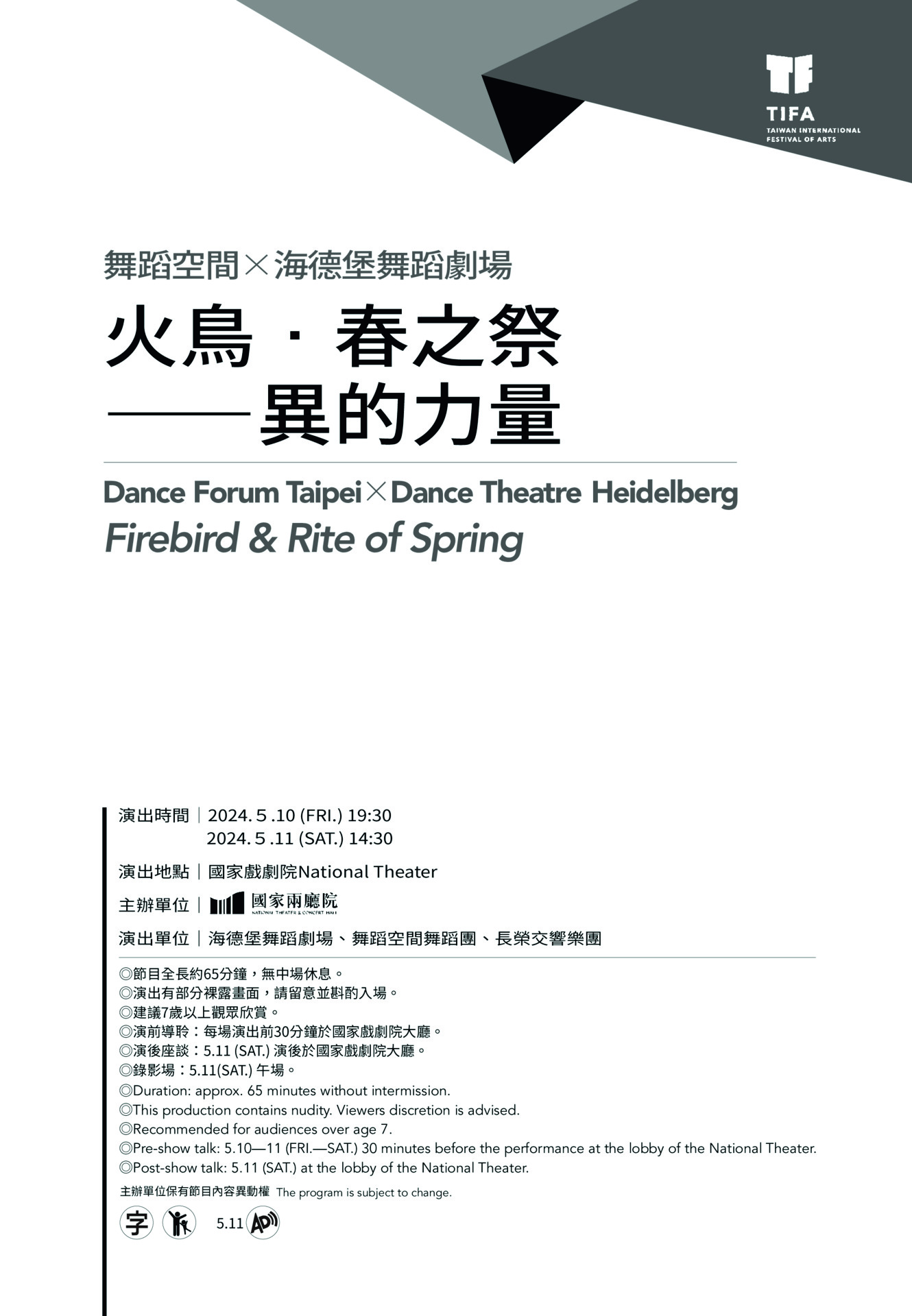
2024TIFA 舞蹈空間✕海德堡舞蹈劇場《火鳥.春之祭─異的力量》
Dance Forum Taipei & Dance Theatre Heidelberg: Firebird & Rite of Spring
基本資料
2024-05-10
2024/05/10 07:30
2024/05/11 02:30
TIFA,劇場中的多重宇宙
劇場裡的時間不是線性的,過去、現在與未來,常常同時出現,相互糾纏。而藝術家們總是那麼敏捷的穿梭其間,時而從記憶中取材,時而站在未來回望。彷彿是旁觀者的我們,則常常要忍不住驚呼:「現在既是過去,同時也是未來!」
今年,我們想邀請大家,穿梭劇場裡關於時間的多重宇宙。除了重溫無數讓人流連忘返、心跳加速的時刻,藝術家亦不約而同在歷史傳統的豐富與輝煌中,以不同的形式,發出與未來共振的頻率,自經典找尋創新的能量,或以創作探討現代社群關係。甚至,跳上科技打造的時光機器,回到事件現場,藉由作品與我們對話。
所以走吧!現在讓我們跟著無極限的藝術家們,一起穿梭在劇場裡的多重宇宙。「過去可以重現,未來伸手可及」,這已不再是物理學家的功課,而是你我的當下!
編舞家的話
伊凡.沛瑞茲 ( 編舞家 )
2015、2018 年,我有幸能與舞蹈空間合作《迴》、《BECOMING》兩檔製作,並曾在台灣國際藝術節演出。2021 年與海德堡舞蹈劇場的舞者共同創作《火鳥.春之祭》時,尚未想到這部作品會牽起我與舞蹈空間的第三度合作,特別是在舞蹈空間成立 35 週年的重要時刻。藉此,特別感謝駱宜蔚、蘇冠穎兩位舞者,他們過去皆任職舞蹈空間,而後和我一起加入海德堡舞蹈劇場,他倆是原創舞者,也是將作品轉交至舞蹈空間的功臣。
2024 年,他們將與所有舞者攜手登上國家戲劇院和衛武營歌劇院的舞臺,同時,也很榮幸能與指揮簡文彬先生與長榮交響樂團,共同延續美好的緣分。
由米契爾.佛金(Michel Fokine)編舞的《火鳥》1910 年於巴黎首演時,獲得熱烈迴響,其主因在於與作品同名之主角的異國色彩,這段過往讓我反思「火鳥」一詞在現今社會代表的意義。火鳥本身充滿矛盾,牠虛幻、神秘而狂野的諸多面向,讓我們想要據為己有,又想將其去之而後快。異國色彩喚起慾望與力量,人們是既艷羡又抗拒。這些對「異己」、「他者」的區分,正反映出隱藏的社會傾向,這些相互衝突的感知,仍需我們努力去充分理解。
而瓦斯拉夫.尼金斯基(Vaslav Nijinsky)《春之祭》中殘酷的活人獻祭是舞蹈史上的指標性場景,這引起我的注意,因為「集體行為」向來是我在作品中重複探究的主題。在此,我更關注的是人類本性中暴力的起源,例如,某些跡象顯示,「模仿」可能造成去人性、混亂與疏離。在尋找救贖的過程中,「天選之人」的犧牲,原應要讓我們在舞臺上所建立的社會重獲和平,但我亦反問自己:暴力的循環該如何才能結束?為了讓人性抱有希望,這個社群將走出命運,帶著同理心加入犧牲者的獻祭之舞。
在編舞方面,我與舞者們對創造「民間傳說」特別感興趣,想為這個社群創造一種原創語言。我們探進史特拉汶斯基的音樂與作曲的重重結構,窺見作曲家運用不規則節奏韻律,塑造出壯觀的部落環境。對我而言,音樂與舞蹈在形式與內容,也在樂曲與身體語彙間闢出彼此對話的空間。複雜的編舞將戲劇性且富有表現力的片刻交織在一起,充滿著張力、節奏與能量。由二十二位才剛認識的表演者一起演出,幾可說某種社會實驗已在我們的眼前展開。
舞作介紹
《火鳥》與《春之祭》在廿世紀誕生時就相當「異數」。《火鳥》是晚期浪漫主義管絃樂語彙的最終表達方式,史特拉汶斯基在和聲與配器的破格,讓他一戰成名;而編舞家佛金與之搭配的舞蹈,雖還保有芭蕾舞劇中常見的火鳥與惡魔善惡角色之分,但已不復見傳統的四幕分段,也沒有古典芭蕾制式的旋轉、跳躍等炫技場面,讓角色情緒完全融入至音樂中。史氏的《春之祭》更打開全新的音樂世界,管絃樂色彩與聲響效果的震撼完全不同以往,因此被指揮伯恩斯坦(Leonard Bernstein)譽為「廿世紀最重要的作品之一」。而尼金斯基的舞蹈創作,雖頗符合史氏的想像,但穿著原住民服飾、內八跺腳的獻祭儀式舞蹈,出乎大家想像,驚嘆與厭惡的觀眾爭論不休,甚至大打出手。
百年前這種對「異」的極端態度,引發伊凡.沛瑞茲的創作動機,首開先例串連兩曲,將《火鳥》做為序曲,先創造一個被眾人孤立,但可能也令人嚮往的角色,理想世界最終被「自我」與「他者」群體對立的《春之祭》所摧毀。異於一般選擇女性做為被犧牲的獻祭者,伊凡此次選擇由男舞者來擔綱,性別的轉換,呈現出百年來人類社會的演進、轉變,並賦予舞作當代的意義。
編舞家沛瑞茲是西班牙人,在荷蘭展開舞者及創作生涯,現在旅居德國。四處巡演及創作的經驗,讓他深刻體會到作為「異鄉人」的美麗與哀愁。他喜歡在作品探討人性中的社會效應、個體在面對孤獨時的狀態,這是長期身為異鄉人的觀察,他也因此學會成為一個異鄉人。
為慶祝舞蹈空間 35 周年,沛瑞茲率海德堡舞蹈劇場團員一起前來,由簡文彬指揮長榮交響樂團現場演出。九十九位藝術家如何在舞臺上從容應對「群體」與「異者」的關係,將不只是舞臺上的 65 分鐘演出,也會是值得關注的人生議題。
關於演出者
編舞家:伊凡.沛瑞茲
1983 年出生於西班牙,現居德國海德堡。曾為荷蘭舞蹈劇場(NDT)舞者,2011 年在荷蘭科索劇院支持下展開編舞生涯,受邀為荷蘭舞蹈劇場、西班牙國家舞蹈團、莫斯科芭蕾舞團、英國芭蕾男孩及臺灣舞蹈空間等國際舞團編舞。2018 年起擔任海德堡舞蹈劇場(Dance Theatre Heidelberg)藝術總監迄今。
指揮:簡文彬
1967 年生,國立藝專(今國立臺灣藝術大學)鍵盤組畢業,維也納音樂暨表演藝術大學指揮碩士學位。1996 年起擔任德國萊茵歌劇院(Deutsche Oper am Rhein)駐院指揮長達 22 年;1998 至 2004 年為日本太平洋音樂節(Pacific Music Festival)駐節指揮; 2001 至 2007 年為國家交響樂團(NSO)音樂總監,2014 至 2016 擔任國立臺灣交響樂團藝術顧問,2014 年起任衛武營國家藝術文化中心藝術總監,並於該年獲頒第十八屆國家文藝獎。
海德堡舞蹈劇場
為海德堡劇院及交響樂團於 2018 年成立之專屬常設舞團,舞者來自比利時、巴西、丹麥、法國、西班牙、臺灣和烏克蘭等國,是一個包容性極高,善於營造藝術家之間對話與交流的舞團。其創新且多樣化節目、高品質製作及獨到當代美學,深獲觀眾及舞評肯定,並持續以推廣活動開發基層舞蹈社群。
舞蹈空間舞團
臺灣當代舞蹈創新指標團隊,由國家文藝獎舞蹈類得主平珩於 1989 年創立,至今已與五十八位編舞家及一百八十六位藝術家共創九十一個作品,並至臺灣各地及歐美四十個城市展演近千場。2008年起著重國際共製,與歐洲知名劇場及舞團合作。2019 年以「關照表演藝術深度與廣度的全面視角,已創造出獨特且不可或缺的文化價值」獲臺北文化獎肯定。
長榮交響樂團
2001 年成立,為全臺唯一、也是國際間少數由民間法人機構─財團法人張榮發基金會經營的職業交響樂團。2007 至 2023 年間,由葛諾.舒馬富斯(Prof. Gernot Schmalfuss)擔任音樂總監暨首席指揮,曾與世界三大男高音及各界名家合作演出,2004 年起開始海外巡演,足跡遍達歐、美、亞、澳各地, 2013 年起並與世界知名德國 CPO 唱片公司合作發行多張專輯。
演出製作群
編舞、導演:伊凡.沛瑞茲
音樂:伊果.史特拉汶斯基
音樂指導:Elias Grandy
指揮:簡文彬
服裝設計:Sofie Durnez
服裝顧問:林璟如
服裝製作:黃宇聰
燈光原創:Tanja Rühl
燈光設計:黃申全
編舞助理:Jorge Soler Bastida
排練指導:陳凱怡
排練助理:駱宜蔚、蘇冠穎
舞蹈構作:Marcos Mariz
藝術統合:Renan Martins
巡迴經理:Adrián Castelló
製作團隊:平珩、葉瓊斐、黃申全、 李依璇、宋郁晴、黃佳彗、 李庭宇
技術團隊:王宣文、朱薇婷、余祖瑩、 林維辰、許哲晟、葉岫穎、 詹鈞如
音樂演奏:長榮交響樂團
舞者:
海德堡舞蹈劇場:
Inés Belda Nácher、駱宜蔚、Mathias Theisen、Thamiris Carvalho、Andrea Muelas Blanco、Adrien Ursulet、Jochem Eerdekens、Lucía Nieto Vera、Julia Kosalka、Marc Galvez、蘇冠穎
舞蹈空間舞蹈團:
黃彥傑、林思綺、葉晉誠、張代欣、蔡貽亘、羅廷瑋、陳姵琪、張琪武、吳冠儀、劉彥佩、楊敏瑄
贊助:國藝會 113 年演藝團隊年度獎助專案
特別感謝:王雲幼、陳以亨、馮玉芳、臺北市立交響樂團、長興材料工業股份有限公司、菁霖文化藝術基金會
《火鳥》獲 Schott Music GmbH & Co. KG. 同意演出;《春之祭》獲 Boosey & Hawkes Music Publishers Limited 同意演出。
持本場館當日節目票觀眾,請至廳內折抵機辦理停車優惠
歡迎掃描 QR Code 線上填寫「
觀眾意見調查表
」
感謝您費心填寫!
友善環境:國家兩廳院印刷品皆選擇使用大豆油墨物料。
演出中孩童陪伴服務:國家兩廳院在演出期間提供4-8歲孩童陪伴服務,詳細資訊請見
兩廳院官網
。
TIFA, Multiverses in Theater
The concept of time in theater is inherently non-linear. Artists deftly navigate between the simultaneously existing and entangled past, present, and future. Often, they extract materials from memories or look back at the present from the perspective of the future. As spectators, we marvel at the fluidity of time and exclaim: "The present is simultaneously the past and the future!"
For the 2024 TIFA, we invite audiences to traverse the temporal multiverses. We aim to revisit those unforgettable, exhilarating moments. Artists draw from their robust and radiant traditions to create works in a variety of formats that resonate with future. They rediscover innovative power within the classics or explore contemporary social interaction through creativity. We can even hop on a time machine created through technology to return to the site of an event, to engage in dialogue through the work.
Join us in this journey! Let's accompany the boundary-defying artists as we navigate between the multiverses in theater. "The past can be revisited, and the future is within reach." This journey transcends the realm of physics; it is our present moment.
Choreographer's Note
By Iván Pérez (Choreographer)
I had the honor to work with Dance Forum Taipei in 2015 with Hui and 2018 with BECOMING during TIFA, Taiwan International Festival for the Arts. In 2021 when I created Firebird & Rite of Spring with the dancers of the Dance Theatre Heidelberg (DTH) in Germany, I could not have imagined that a new version with Dance Forum Taipei (DFT) would mark our third collaboration, and the company´s 35th anniversary. We are also here to celebrate two great artists that joined me in DTH after departing from DFT, Lo Yi-wei and Su Kuan-ying. They were part of the original creation and are responsible for its transmission to DFT. Together, they will all perform on these incredible stages, the National Theater and Concert Hall and the National Kaohsiung Center for the Arts (Weiwuying). The honour continues as Chien Wen-pin will conduct the Evergreen Symphony Orchestra.
When Michel Fokine premiered
The Firebird
in Paris in 1910, the main character, which also gives the piece its name, attracted enormous public interest due to its exotic attributes. This history inspired me to question what this figure could mean today, which for me embodies contradictory qualities. Its exotic character marked by both sensuality and power provoke not only attraction but also rejection. This is regarded as “different”, as “the other one”, and exposes our ambiguous social tendencies. In this interpretation, we get to know the firebird by revealing its different facets: mythical, enigmatic and wild. As a result, we want to possess this being, and at the same time, we want to eliminate it. This contradictory feeling remains an essential part of our struggle to understand it well.
The final scene of Vaslav Nijinsky's
The Rite of Spring
has become iconic in dance history for showing a brutal human sacrifice. This caught my attention as collective behavior has been a recurring theme through most of my work. In this case, I am interested in the origin of violence in our nature. We discovered, for instance, there is a sense of how imitation leads to dehumanization, chaos, and alienation. In the search for salvation, sacrificing a “chosen one” is supposed to restore peace in this community on the stage. However, I ask myself. How can this cycle of violence come to an end? Thus, as an attempt to offer hope to humanity, the group deviates from its fate and joins the victim in the sacrificial dance in an act of empathy.
Choreographically, the dancers and I were interested in the creation of folklore, and together we created an original language for this particular community. We dived in Stravinsky's music and its rich compositional structures, in which rhythms based on irregular patterns form a spectacular tribal environment. For me, music and dance intertwine in a conversation between form and content, between musical composition and physical dramaturgy. Complex choreographic passages intercept with dramatic and expressive moments full of tension, rhythm, and energy, performed by a group of 22 performers who literally just met. One could say, it is a sort of social experiment, unfolding in front of our eyes.
Synopsis
The Firebird
and
The Rite of Spring
have been “outliers” of the art since their creation in the twentieth century.
The Firebird
is the ultimate expression of late-Romantic orchestral style; Igor Stravinsky's unconventional choices in harmonization and instrumentation quickly gained him remarkable success. The accompanying choreography by Michel Fokine, in the form of the firebird and evil sorcerer, retains the commonly seen division of good versus evil characters in story ballets. However, it no longer follows the traditional four-act form, or demands that dancers showcase impeccable skills with formal classical ballet turns and jumps; rather, it allows the characters to be fully absorbed in emotions depicted in the music. Stravinsky's
The Rite of Spring
, moreover, was an eye-opener into a brand-new music horizon. Its vibrant orchestra timbres and spectacular sound effects were unprecedented, earning the acclaim as “one of the most important works of the twentieth century” from conductor Leonard Bernstein. Vaslav Nijinsky's choreography closely reflects Stravinsky's vision, but the folkloric costumes and ritual dances with knock-kneed stomping were so unexpected, they caused much controversy and even physical altercations among the audience members who found the performance surprising or abhorrent.
Such extreme reactions to “the other” a century ago sparked the creative inspirations of Iván Pérez. Setting the precedent of connecting the two pieces, Pérez used
The Firebird
as an overture, devising a widely ostracized yet perhaps desirable character, before the idealistic world is eventually demolished in
The Rite of Spring
by collective antagonism between the “self” and the “other”. Unlike most works, which cast female characters as the sacrificial victims, Pérez’s production chooses a male dancer for the role. The reversal of gender roles displays the transformations in human society over the past century, attaching contemporary significance to the work.
Iván Pérez is a Spanish choreographer who began his dancing and creative career in the Netherlands, and now resides in Germany. Through the journey of touring and creating, Pérez gained a deep understanding of the wonders and sorrows of being a “foreigner”. He said, “In my works, I enjoy exploring the societal effects of humanity and the state of the individual when facing loneliness. These are based on my longterm observations as a foreigner, and in this process, I have also learned to become a foreigner.”
In celebration of Dance Forum Taipei's 35th anniversary, Pérez visits Taiwan with Dance Theatre Heidelberg. They will be accompanied by the live performance of Evergreen Symphony Orchestra, conducted by Chien Wen-pin. How will these 99 artists placidly address the relationship between the “collective” and the “other” on the stage? In addition to being featured over a compelling 65-minute performance, this will also be an intriguing issue to explore for life.
Performer Introduction
Choreography and Direction: Iván Pérez
Born in Spain in 1983, Iván Pérez began his career as a dancer with the Netherlands Dans Theater (NDT). He created and set work for international companies such as BalletBoyz, Ballet Moscow, Compañía Nacional de Danza, and Dance Forum Taipei, amongst others. Since 2018, he is the Artistic Director of Dance Theater Heidelberg.
Conductor: Chien Wen-pin
Chien Wen-pin, General and Artistic Director of the National Kaohsiung Center for the Arts (Weiwuying), was born in 1967, graduated from the National Taiwan Academy of Arts and awarded with Master degree at the National University for Music and Performing Arts Vienna. Chien joined the Deutsche Oper am Rhein in 1996 and served as “Kapellmeister” for 22 years. He was Resident Conductor of the Pacific Music Festival in 1998-2004 and was Music Director of NSO between 2001-2007. Chien was Artistic Advisor of the NTSO in 2014-2016 and has received the National Award for Arts in 2014.
Dance Theatre Heidelberg (DTH)
Since its founding in September 2018, the newly established dance company has won the trust of audiences and critics with its high-quality productions and contemporary dance aesthetics. The DTH has an international ensemble with dancers from Belgium, Brazil, Denmark, France, Spain, Taiwan and Martinique. It is committed to an inclusive environment and promotes dialogue and exchange between artists.
The DTH's fringe programme, which aims to reach out to all audiences, reinforces the troupe's commitment to developing communities around dance and in the city.
Dance Forum Taipei (DFT)
Dance Forum Taipei is the representative of contemporary dance in Taiwan. Led by Ping Heng as Founder and Artistic Director, the Company has presented 91 productions collaborating with 58 choreographers and 186 designers since its inception in 1989. It has toured close to 1,000 performances, throughout the island of Taiwan as well as 40 major cities in Asia, Europe and North America. DFT received the Taipei Culture Award in 2019 for the unique and indispensable cultural value created from her comprehensive perspective in depth and breadth of performing arts.
Evergreen Symphony Orchestra (ESO)
Founded and supervised by the Chang Yung-Fa Foundation, the Evergreen Symphony Orchestra is exceptional in being the only professional orchestra in Taiwan overseen by a private foundation, and one of but a few of its kind on the international stage. Established in 2001 and led by Prof. Gernot Schmalfuss as music director and chief conductor since 2007 to 2023. ESO has collaborated with many well-known international musicians including the World Three Tenors.
Credits
Choreography and Direction: Iván Pérez
Music: Igor Stravinsky
Musical Direction(HD): Elias Grandy
Conductor: Chien Wen-pin
Costume Designer: Sofie Durnez
Costume Consultant: Lin Ching-ju
Costume Maker: Huang Yu-cong
Original Lighting Design: Tanja Rühl
Lighting Designer: Channel Huang
Choreographic Assistance: Jorge Soler Bastida
Rehearsal Director: Chen Kai-yi
Rehearsal Assistants: Lo Yi-wei, Su Kuan-ying
Dramaturgy: Marcos Mariz
Artistic Collaborator: Renan Martins
Tour Manager: Adrián Castelló
Production Team:
Ping Heng, Yeh Chiung-fei, Channel Huang, Lee Yi-hsuan, Sung Yu-ching, Huang Jia-hui, Lee Ting-yu
Technicians:
Sharon Wang, Chu Wei-ting, Yu Zu-ying, Lin Wei-chen, Hsu Che-sheng, Yap Siew-yin, Chan Chun-ju
Musicians: Evergreen Symphony Orchestra
Dancers:
Dance Theatre Heidelberg
Inés Belda Nácher, Lo Yi-wei, Mathias Theisen, Thamiris Carvalho, Andrea Muelas Blanco, Adrien Ursulet, Jochem Eerdekens, Lucía Nieto Vera, Julia Kosalka, Marc Galvez, Su Kuan-ying
Dance Forum Taipei
Huang Yen-chieh, Lin Si-qi, Yeh Chin-cheng, Chang Tai-hsin, Tsai I-hsuan, Lo Ting-wei, Chen Pei-chi, Chang Chi-wu, Wu Kuan-i, Liu Yen-pei, Yang Min-hsuan
The performance of
The Firebird
is given by permission of Schott Music GmbH & Co. KG.
The performance of
The Rite of Spring
is given by permission of Boosey & Hawkes Music Publishers Limited.
Very appreciate for your feedback! This is an online questionnaire:
Online Questionnaire
《火鳥.春之祭─異的力量》
"Firebird & Rite of Spring"
典藏單位:國家兩廳院,實體文物請至兩廳院表演藝術圖書館申請觀看。
媒體類型:紙本及電子檔

評分
 電話:02-3393-9798 ︳傳真:02-3393-9798 ︳地址:100011 臺北市中山南路 21-1 號
Copyright ©國家表演藝術中心數位典藏系統 版權所有 All rights reserved.
電話:02-3393-9798 ︳傳真:02-3393-9798 ︳地址:100011 臺北市中山南路 21-1 號
Copyright ©國家表演藝術中心數位典藏系統 版權所有 All rights reserved.