 檔案1
檔案1
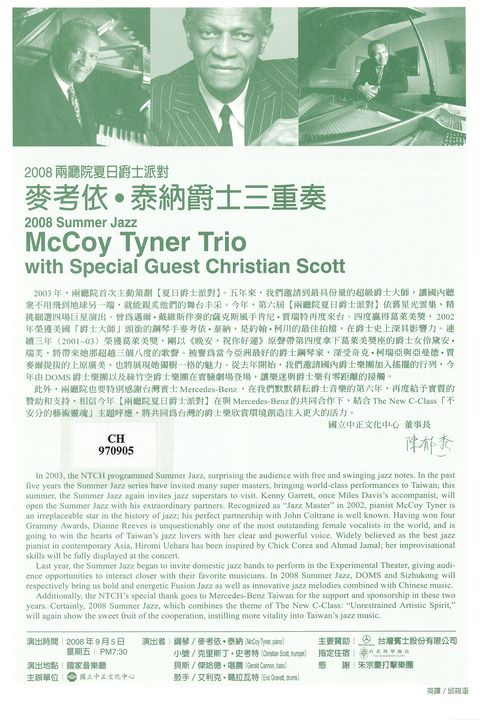
2008兩廳院夏日爵士派對:麥考依‧泰納爵士三重奏
McCoy Tyner Trio
基本資料
2008-09-05
2008/09/05
【真實麥考伊】 ( The Real McCoy ) 是 1967年,鋼琴手 McCoy Tyner 所發行的個人唱片。一般來說這是他最知名的專輯,也是國內爵士樂迷最熟悉的一張作品。1993年,還有三個德國人把 「The Real McCoy」當作自己的團名,幾首歌選登上了告示牌榜單。幾個例子或許能解釋這張唱片的重要性。
Tyner 在爵士樂壇已經打滾了半個世紀,更想不到的的是他即將來台灣舉辦演奏會,樂迷將有機會親身體驗所謂的「真實麥考伊」。於是這篇文字藉唱片的標題為名,試圖從我自己的了解,為大家介紹這位鋼琴手。內容包括他的故事、他的音樂,以及聽演奏會時或許可以參考的一些方向。
費城是美國著名的「大師工廠」,出產了許多爵士史上赫赫有名的大師, McCoy Tyner 就是其中之一。他在1938年12月11日出生,家中三兄弟排行老大。先來段你不知道的八卦,他的弟弟 Jarvis Tyner 是個共產黨員,在「美國共產黨」( American Communist Party ) 組織裡擔任相當高的職位。
McCoy 對政治不太有興趣,不過或許受到了潮流影響,在他18歲時曾經短暫信奉遇伊斯蘭教,還取了個伊斯蘭名字 Sulaimon Salld。
回到音樂。導演 Spike Lee的電影《愛情至上》 ( Mo Better Blues ) 裡有一幕:黑人小朋友被母親押著練小號,幾個朋友在窗外嚷嚷著叫他,想出去玩卻不行......。這畫面 McCoy Tyner 看了肯定會心一笑,他之所以能成為鋼琴手,就是因為小時候母親某種程度的逼迫使然。而大約在二次大戰結束前後吧,鋼琴練著練著練出了興趣,Tyner 決定長大後要當音樂家,當時他15歲。他的爵士底子來自一位好鄰居,同樣是「費城製造」的鋼琴大師 Bud Powell。換句話說,Tyner 擁有最完整堅固的咆哮爵士 ( Bebop ) 概念,這對他後來的發展有決定性的影響。
McCoy Tyner 十幾歲就出來跑場了,不過生平第一次在唱片裡出現卻是1959年的事。當時 Tyner參加了伸縮號手 Curtis Fuller 主持的六重奏,取代了本來的鋼琴手 Tommy Flanagan。樂團裡另外還有前輩小號手 Thad Jon 的與薩克斯風手 Benny Golson 共六人,他們一起錄了張叫作【Imagination】的唱片。這是張好唱片,但廿一歲的 Tyner畢竟是「劉姥姥逛大觀園,頭一遭」,在唱片裡稱不上大鳴大放,但在伴奏和即興獨奏的段落裡至少有為有守,紮紮寶寶。不過 Tyner 只和他們維持了差不多半年左右的合作關係,後來應薩克斯風手 John Coltrane 的召喚,帶著貝斯手 Jimmy Garrison 和鼓手 Elvin Jones,四個年輕人一起組了個新的樂團。先前那個樂團隨後找來了小號手 Art Farmer,成了六○年代呼風喚雨的經典樂團 Art Farmer-Benny Golson Jazztet。但別擔心, Tyner一點沒吃虧!因為他和 Coltrane 的新樂團,後來更成為爵士史上最重要的四重奏組合。
講到 McCoy Tyner 和 John Coltrane 的合作,他們其實已經認識了好一陣子,甚至在 Tyner唱片處女秀之前就有過合作經驗。1958年 Tyner 寫了首歌叫作“The Believer”當時就是 Coltrane 替他吹奏薩克斯風的。四重奏於 1960年成立,就在 Coltrane 剛發表了擲地有聲的 【Giant Steps】專輯之後。他們的首張專輯叫作 【My Favortie Things】,後來陸續推出了包括【Live at the Village Vanguard】、【Live at Birdland】、【A Love Supreme】等許多不朽專輯,音樂史家稱他們的組合為「經典四重奏」 ( The Classic Quartet ) 。很巧的,就在四人往後連續五年幾乎不會停止的巡迴演出裡,“ My Favorite Things”一曲似乎成了他們的最愛,一個比一個精采的版本紛紛出爐,成了樂迷爭相收藏比較的目標。各個版本長度不一,從七分鐘到一小時都有,你可以想像當利害的爵士樂手進入狀況後,一首三分鐘的曲子可以被演奏到超過一小時還欲罷不能的樣子。但有趣的地方在於:這裡我先設定你是個爵士樂迷且聽過他們的“ My Favorite Things”在他們不斷的詮釋下,幾乎奪走了曲子「原始版本」的風光!不信?你現在可以哼上幾句《真善美》裡面的“ My Favorite Things”嗎?眾多版本裡,1963年新港爵士音樂節裡大約十八分鐘的版本,長度與高度都適合,有興趣不妨試試。
McCoy Tyner 和 John Coltrane 總共合作了五年 ( 1960~65 ) ,後來 Coltrane 的音樂逐漸劍走偏鋒,二人於是分道揚鑣。離開了 Coltrane 後, Tyner曾一度在音樂裡迷惘,試圖闖出新路卻未能如願。他隨波逐流了好一陣子,當中還會有段時間擔任歌手 Ike & Tina Turner 夫婦的鋼琴手,玩起了當時流行樂壇正火熱的靈魂樂。不過 Tyner 很快調整好方向,朝著「後咆勃」 ( Post Bop ) 的路線前進。1967到 1970年間,陸續推出了包括這篇文字引為標題的 【The Real McCoy】、【Tender Moments】、【Expansions】和 【Extensions】等精采作品。
Tyner 沒有因離開 Coltrane 而在爵士樂裡隱形,反而以「調式爵士」 ( Modal ) 的概念成功和 Coltrane 晚年的自由爵士 ( Free Jazz ) 作出區隔,建立起個人品牌。
1972年, McCoy Tyner 換了新東家。也從這個時間點開始,他的音樂影響力,逐漸開始成為足以和 Bill Evans 比扁的大人物。上一段提到的「後咆勃」其實是對七○年代後爵士樂一個很模糊的說法,把他拉長點,就是「咆勃爵士之後爵士樂的所有可能」。換句話說,這三個字的範圍很大。
Tyner 的音樂格局很明顯地能從這時期的音樂看出,他清楚「爵士樂是一個有機體,是一個不斷在融合的現在進行式」,於是他選擇擁抱來自世界各地的音樂元素,此時的作品可明顯聽出他將爵士樂與世界音樂融合的野心。比方說 1972年的 【Sahara】專輯,他在“ Valley of Life”一曲裡演奏了日本古箏 ( Koto,一種十三根琴弦的箏琴 ) ,企圖營造出一種東方的氛圍。這時期的 Tyner 喜歡和長笛手 Hubet1 Laws 以及鼓手 Billy Cobham 合作,音樂中揉雜了非洲與亞洲的元素,呈現出別於當時「融合爵士」 ( Fusion ) 與自由爵士的風味,自成一格。進入八○年代後, Tyner 常和固定的鋼琴三重奏班底,貝斯手 Avery Sharpe 和鼓手 Aaron Scott,巡迴世界表演。此後的合作對象當然偶有更替,不過廿多年來作品不斷,直到今天依舊活躍。
以上是關於鋼琴手 McCoy Tyner,從出生到現在,我所能夠和你分享的所有資訊。然而音樂是用聽的,光文字哪能止癢?!所以打算利用最後篇幅來聊聊他的演奏,或許在聽他現場演出時,也能夠看出些像是「啊 !這是他的得意技!」之類的門道。其實Tyner的鋼琴辨識度很高,左手在處理節奏的時候總像和鋼琴有仇,手舉得高高的,像個榔頭般持續重擊鍵盤。因此,他的低音處理有點像是瘋狗浪,而且是怒滔拍岸的那種。至於他的右手,則跟著曲子的調性作出有如「明湖居聽書」裡的白妞唱歌般上天下地的即興,時而黏滯,時而脆爽。當然,演奏時是左右手一起進行的。所以給你一個方向去想像:鋼琴手的右手在鍵盤上前後左右上下流暢即興的同時,左手肘舉得高高的,不停在正確的時機點重槌出擊,像是轟炸自己右手即興出來的音符。如果你心中出現了位鋼琴手這麼演奏著的畫面,或許你大概已對 Tyner的演奏特色稍稍有譜了。如果沒有,怪我文字能力低落,就請你自己去看他吧 !反正馬上就來了,不是嗎?
The Real McCoy by Daniel Shen
After nearly half a century in the jazz circles, one of the world’s most influential master pianists McCoy Tyner is finally coming to perform in Taiwan. Having toured frequently around the world for more than 20 years, presenting his highly identifiable performances and ceaselessly producing new works of his renowned Post Bop music, this time, Tyner offers music fans in Taiwan the opportunity to experience for themselves“the Real McCoy.”
The Real McCoy is probably Tyner’s best-known album, and the one that Taiwan jazz fans are most familiar with. Its title was adopted by three German musicians to name their band in 1993, and a few of their songs even made the Billboard charts. As a most important work of Tyner’s and being representative of a turning point in his career, however, it was not until 1967 that“The Real McCoy” had been“released .”
McCoy Tyner had not always , fe1t so“destined” to be a musician,though he was born, December 11th 1938, in Philadelphia, a city famous for“producing” many notable jazz masters in the history. There was a scene in director Spike Lee’s movie Mo’ Better Blues, in which a kid yearning to go out and play was practicing trumpet under the “supervision” of his mother, while a couple of his friends hollered for him from out the window. This scene would probably draw from Tyner a knowing smile, as he himself might not have become the pianist he is today but for a certain amount of pressure from his mother. It was only after years of endless practice that Tyner actually grew interested in piano, and at the age of 15 decided to become a pianist. His initial understandings of jazz music were inspired by Bud Powell, one of the key musicians in the development of Bebop, which meant that Tyner also possessed a solid, integral idea of Bebop, and this came to have critical influences on his later career.
Though having started performing in his teens, Tyner did not make his first recording appearance until 1959. At that time Tyner had joined the sextet led by trombonist Curtis Fuller, in place of their original pianist Tommy Flanagan. The ensemble also included trumpeter Thad Jones and saxophonist Benny Golson, and together they recorded an album titled Imagination. The album received general approval, and though Tyner did not outshine the others with his performance, he did display his skills, playing the accompaniment and improvising solos without fail. After only about half a year, however, Tyner left the sextet, accepting the invitation of saxophonist John Coltrane, and together with bassist Jimmy Garrison and drummer Elvin Jones, the four young musicians founded a new band. Fuller’s ensemble was soon afterwards joined by trumpeter Art Farmer to become the most influential ensemble of the 60s, the Art Farmer-Benny Golson Jazztet.
But Tyner suffered no loss; since its founding in 1960, starting with their first album My Favorite Things, the new quartet went on to produce numerous monumental albums, including Live at the Village Vanguard, Live at Birdland, and A Love Supreme. Music historians called them“The Classic Quartet,”and they came to be the most important quartet in jazz history. In the following five years, the quartet went on endless tours, during which the song My Favorite Things seems to have become their favorite. They created one spectacular new version after another, each of which music fans enthusiastically collected and compared with one another. In fact, new interpretations of the song were so many that they near out-did the original version; perhaps even a jazz fan who knew the song could not immediately recall the version in Sound of the Music.
McCoy Tyner and John Coltrane had in fact been acquainted for some time before creating the quartet. The two had worked together even before Tyner’s record debut: in the song titled The Believer that Tyner had written in 1958, it had been Coltrane who had accompanied him on saxophone. But after working together for five years (1960~65), each went his own way as Coltrane’s music grew gradually dependent on unconventional peculiarities. Tyner was at a loss for a time, attempting to explore a new path in music but without success. He drifted along for a while, sometimes accompanying singers Ike and Tina Turner on piano, and even had a taste of the then popular Soul Music. But he soon managed to re-adjust his steps and found his way towards Post Bop. It was through 1967 to 1970 that Tyner released The Real McCoy, Tender Moments, Expansions, Extensions, and other outstanding, significant works. He did not fade out from the jazz world for parting with Coltrane; on the contrary, with his concept of Modal Jazz, Tyner successfully distinguished his style from the Free Jazz Coltrane adopted in his late years, and thereby established his own distinctive signature.
Post Bop is in fact a vague generalization of all jazz styles after the 70s, which could include“all possible jazz music after Bebop,”and that went well with the spirit of Tyner’s musical style. He knew well that“jazz mucis is an organism, a present progressive that never ceases merging in new things,”and therefore he chose to embrace musical elements from all over the world. Tyner’s works from this time clearly displayed his ambition to incorporate world music into jazz. Take for example his 1972 album Sahara; in the song Valley of Life Tyner performed the 13-stringed Japanese zither Koto in attempt to create an East-Asian aura. At this time Tyner preferred working with flutist Hubert Laws and drummer Billy Cobham. He kneaded into his music African and Asian elements, presenting a distinctive style different from Fusion or Free Jazz. After the 80s, Tyner performed more often on tours in a piano trio, with Avery Sharpe on bass and Aaron Scott on drums. He worked with different partners occasionally, and has remained active in the jazz world as of today.
In enjoying Tyner’s performance, most noticeable is probably his instantly recognizable style. His left hand controls the rhythm, striking the keyboard continuously like a hammer, as though the piano was his enemy, making his low bass sound like rogue waves, the kind that rolls roaringly and beats the shore furiously. At the same time, his right hand improvises in accordance with the varying tonality going from high like the sky to low till near inaudible, sometimes viscous like lava, sometimes crisp and clear. Thus we can perhaps picture this pianist: right hand improvising freely and fluidly, left hand pounding down with accurate timing, bombarding the notes just improvised-“the Real McCoy,” coming soon.
麥考依‧泰納爵士三重奏
McCoy Tyner Trio with Special Guest Christian Scott
典藏單位:國家兩廳院,實體文物請至兩廳院表演藝術圖書館申請觀看。
媒體類型:紙本及電子檔

評分
 電話:02-3393-9798 ︳傳真:02-3393-9798 ︳地址:100011 臺北市中山南路 21-1 號
Copyright ©國家表演藝術中心數位典藏系統 版權所有 All rights reserved.
電話:02-3393-9798 ︳傳真:02-3393-9798 ︳地址:100011 臺北市中山南路 21-1 號
Copyright ©國家表演藝術中心數位典藏系統 版權所有 All rights reserved.