 檔案1
檔案1
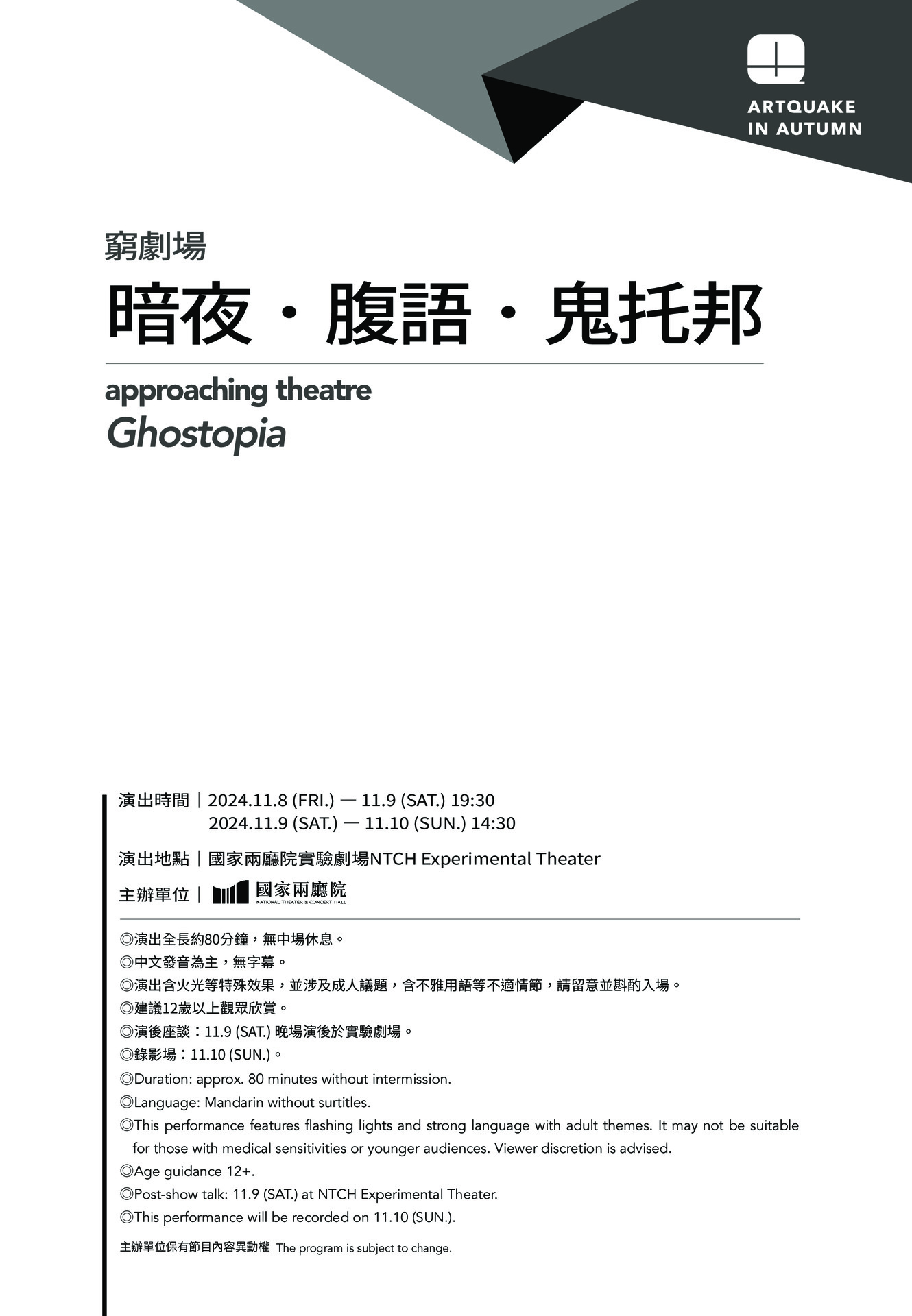
2024秋天藝術節 窮劇場《暗夜.腹語.鬼托邦》
approaching theatre: Ghostopia
基本資料
2024-11-08
2024/11/08 07:30
2024/11/09 02:30
2024/11/09 07:30
2024/11/10 02:30
看不見的岸
從岸離開,靠岸抵達。岸是此時此刻的現在,也是未知的理想境地,在可能抵達的他方。
人類歷史中,移動是常態,我們總是存在在「之間」。在停留和動身之間、在離岸文化、環境、他人,彼此交疊的軌跡,勾勒出我們存在的形狀。
今年秋天藝術節以「看不見的岸」為題,講述此岸到彼岸的路途中,所經驗的、被抹除的、斷裂的與縫補的一切,及在漂泊之間,抵達和未曾抵達的故事。旅途上的所見所想,改變了踏上旅程的我們,而我們和自己及世界的新關係也由此而生。
主創者的話
高俊耀
蜷川幸雄在《千刃千眼》提到:「我認為一切都在舞臺上,或者說都包含在舞臺裡。」所以他不太在節目單以文字說明演出意圖。想想也是。演出之前,採訪、報導、各種宣傳露出,明示暗示,大致上已經把演出前前後後掏了個明白,關於什麼、想法哪來、會怎麼做⋯⋯等等等等。
既然如此,那就說個故事吧。
多年以前在老家,因為某些變故,餐廳生意急需支援,我即刻辭掉在城市的工作回家幫忙。工作的那段期間,時間表大致如下:凌晨 4 點多起床,5 點開始協助媽媽賣早市咖哩飯菜,接近中午前會補眠兩個小時,中午後協助爸爸熱炒生意,下午 2 點到 5 點是休息的黃金時間,5 點後開始準備晚市,夜晚 12 點前結束營業。一天下來,約莫工作十到十四個小時。於是在那日復一日的時光中,青春年華的當時,常常沒來由的焦慮、鬱悶,人生就這樣了嗎?還可以做點什麼呢?可是身體在極度勞累之下,一有休息時間,不是想打個盹,就是想看些輕鬆娛樂的影片,怎麼還有力氣撿拾讀戲劇系時買的一大堆書。
或許就是這樣契機種下了自嘲的本事,用挖苦緩解焦躁,用歡笑趕走憂傷。不然該怎麼辦?眼下這刻真的想不到其他方法,難道終日繃著臉皮就會好轉?也或許,太害怕自己會陷入那自憐自傷的狀態,只好賣力用笑聲取代尷尬,用幽默應對困境。
我想喜劇應該就是如此,把無法說出的事情陌生化,然後用不足為外人道的卑微一點一點堆積上去,大家就笑了。
節目介紹
烈日當空,一名驅魔師踏進了一棟準備都更的舊大樓,在黑夜般的廊道,他遇見了一名女鬼。複聲疊影,明暗相峙,她向他說了一個故事,把時空拉到了 1950 年代,還屬於英國殖民統治的馬來亞。時值英政府與馬共游擊隊激烈對抗,在畢利斯計劃(Briggs Plan)造就的新村中,一名女子處於英國軍官和游擊隊成員的情感夾縫中,在存活與背棄之間面臨了關鍵的抉擇。演出以諧擬、杜撰造境,在寫定的歷史腳本中開闢歧路,複寫身世,虛構一段愛恨交疊的前塵往事,雖生猶死,雖死猶生,譜一曲大時代下荒腔走板的擾民擾事。
演出單位:窮劇場
來自高俊耀(馬來西亞)和鄭尹真(臺灣)的劇場組合,以窮為本,究本源之心。編導演創作與戲劇教育、出版並進。作品關注歷史語境之中的權力建構與主體認同,致力尋找文學與戲劇、古典與當代的銜接轉譯。窮劇場表演美學,本於亞洲傳統藝術的靜定內蘊,深耕劇場的審美和思辨,以劇場藝術擴延交流無盡的文化場域,持續美學追索的創作實踐。
主創人員介紹
導演、編劇、演員:高俊耀
窮劇場藝術總監、ACC 亞洲文化協會受獎人。當代劇場導演、編劇、演員。曾擔任戲劇顧問、表演導師等。因文學而劇場,在劇場以獨特的鏡頭美學意識來調度舞臺,深耕審美思辨。長年探索當代表演者身體與意識之訓練,屢受邀赴東南亞、香港、澳門合作。作品擅長以複聲語境流動敘事,探問晚期資本主義的主體建構,和歷經殖民歷史的華人離散及身分認同。
作品有《感謝公主》台新藝術獎年度大獎、傳藝金曲獎評審團獎;《大世界娛樂場 II》牯嶺街小劇場年度節目、台新藝術獎年度入圍;《死亡紀事》牯嶺街小劇場年度節目;《忿怒》臺北藝穗節明日之星等殊榮。出版著作有《親密:高俊耀劇作選》。
演員:鄭尹真
窮劇場藝術總監。劇場演員、表演教師、業餘讀者。ACC 亞洲文化協會受獎人。國立政治大學新聞學系、國立臺北藝術大學劇場藝術創作研究所表演組畢業。曾任職獨立文化媒體《破週報》、江之翠劇場、臺北書院。創作關注聆聽審美之中所折射的歷史處境與政治狀態。長年潛心探索脫胎於傳統戲樂之聲法、身度、氣韻,建立以靜為底藴之表演美學。2021 年,以莎劇獨角戲《母親.李爾王》獲選台新藝術獎年度入圍。2023 年,參演《感謝公主》獲得台新藝術獎年度大獎。
舞臺設計:羅婉瑜
現任囝仔人團長,舞臺、視覺、裝置設計。深受物件、物質的變異可能吸引,從造型、色彩以及動態發覺物件的展演可能性,擅長將科普知識、科學實驗納入創作路徑,關注過程的視、聽反應現象,與背後可乘載的象徵意義。
燈光設計:吳峽寧
畢業於國立臺北藝術大學,現為僻室House Peace 團員。
2017 年獲世界劇場設計展新銳組燈光設計銅獎,近期專注燈光與影像領域創作。
除劇場設計外,作品亦於寶藏巖光節、月津港燈節等展出。
音樂設計:林育德
曾參與江之翠劇場、窮劇場共製《感謝公主》,窮劇場《大世界娛樂場III》、《親密》等製作。2023 年參加 C-LAB CREATORS 創作/研發支持計畫、推廣現場編程音樂 (livecoding)。劇場之餘也為空間、影像製作聲響。
服化設計:林俞伶
現為韻曄時尚工作室(Summer Studio)設計總監,劇場服裝設計師。曾任玄奘大學、華岡藝校兼任講師。
動作指導:田孝慈
現為自由藝術工作者,從事創作、表演與教學。近年專注於觀察時代、歷史、文化與環境所形塑並建立於人之上的情感,及其透過身體表述之形式。透過經常與舞蹈、劇場、視覺與行為藝術等展演合作及國際交流活動,持續開展身體動態的諸多可能樣貌,並企圖經由身體連結相異文化與多元藝術領域。
名詞注釋
馬來亞共產黨:
簡稱馬共,於 1930 年成立,旨在反抗殖民統治,先後對抗日軍和英殖民政府。1957 年馬來亞獨立後,馬共接受中共援助,以森林游擊隊的形式,繼續對抗被視為英國傀儡的馬來亞政府,勢力一度遍布新馬。
緊急狀態:
馬來亞緊急狀態(1948-1960)是指馬共發起武裝鬥爭後,英殖民政府宣布的全國性緊急狀態。這期間,英國軍隊與馬共武裝力量進行了 12 年的游擊戰。
畢利斯計劃(Briggs Plan):
英國將軍哈羅德.畢利斯(Sir Harold Briggs)於 1950 年制定的軍事計劃,遍及全馬的華人新村自此形成。此計劃不僅打擊馬共的後勤支援,也對戰後馬來半島的華人聚落產生深遠影響。新村(New Village):新村是英殖民軍事策略形成的歷史產物,遭迫遷的華人被集中在此定居生活,以防止他們向馬共提供物資、情報及招募新成員。現許多新村已經城鎮化,也有一些因人口外移而廢棄。
割膠:
「膠」指的是橡膠樹,「割膠」即是用膠刀在樹皮上割出切痕,隨後將溢出的樹汁收集到收購站售賣,可製成橡膠。1950 至 70 年代,馬來西亞曾是世界最大的橡膠生產國,有著「橡膠王國」的稱號。
金馬倫高原:
馬來西亞著名避暑勝地,位於馬來半島彭亨州西北部,海拔約 1500 公尺。自英國探測家金馬倫爵士 (Sir William Gordon Cameron)發現後,英國高官便在此建設別墅、成立軍營,並發展茶葉種植,直至二戰結束。
馬票:
新馬地區「彩劵」的說法,也有別稱「萬字」(其前身為「千字」)。大伯公千字圖:《千字圖》是彩票圖鑑,也是一種解夢書,內容是《千字文》的 1,000 個漢字,每個字都配有一張圖片和一組數字(從 000 到 999)。賭客可以根據夢境或生活中的經歷,找到相應的號碼作為下注參考。
Love is real, real is love:
此為劇中情詩段落,文字節選自約翰.藍儂歌曲〈Love〉的歌詞。此曲收錄在 1970 年發行的經典專輯《John Lennon / Plastic Ono Band》。
唔好阻住地球轉:
粵語俚語,中譯為「不要擋著地球轉動」。意指不要讓一個人的行為拖慢世界的正常運作。
《威尼斯商人》:
莎士比亞經典劇本,講述威尼斯商人 Antonio 為幫助好友 Bassanio 娶得 Portia,而向仇家——放高利貸的猶太人 Shylock 借錢,並答應若無法還錢,就割下自己的一磅肉抵債。不料,他的商船在海上遇險,無法如期還款,被 Shylock 告上了法庭。最終在 Portia 機智的法律辯護下,Antonio 得以免除契約的故事。
演出選取的臺詞
選自《威尼斯商人》:
告訴我愛情從何處萌發?
是在腦海?還是在心房?
愛是怎麼發生?如何滋養?
回答我、回答我。
Tell me where is fancy bred,
Or in the heart, or in the head?
How begot, how nourished?
Reply, reply.
《帝女花》的注釋與唱詞選段:
《帝女花》是香港著名粵劇劇作家唐滌生的劇本,改編自清朝戲曲家黃燮清編寫的同名崑劇。劇情講述明朝長平公主與駙馬爺周世顯自盡殉國的淒美故事。
演出唱詞選段:
落花滿天蔽月光,借一杯附薦鳳臺上
帝女花帶淚上香,願喪生回謝爹娘
我偷偷看,偷偷望
佢帶淚帶淚暗悲傷
我半帶驚惶,怕駙馬惜鸞鳳配
不甘殉愛伴我臨泉壤
寸心盼望能同合葬
鴛鴦侶相偎傍,泉臺上再設新房
地府陰司裡再覓那 平陽門巷
演出唱詞選段之革命改編版:
落街無錢買麵包,靠賒我又怕被人鬧
勞動者眼淚滿腔,願化身民族 model
Look the sky, Tell me why
殖民殖民暗悲傷
我半帶希望,怕弱勢飄零現況
不敢一切奉獻蕩然無樣
要想勝利憑同合作
三合一不分離,Malay, Indian and Chinese
手足並肩破浪覓那 自由岸
演出製作群
編導:高俊耀(馬來西亞)
演出人員:高俊耀、鄭尹真
舞臺設計:羅婉瑜
燈光設計:吳峽寧
音樂設計:林育德
服化設計:林俞伶
動作指導:田孝慈
粵劇指導:袁學慧
主視覺設計:蕭羊希
製作人:張麗珍
行銷票務:吳婉鈴
執行製作:景婉綺
導演助理:郭家妤、梁家恩
舞臺監督:張以沁
舞臺技術指導:許宗仁
舞臺技術人員:王彥硯、方琬婷、吳修和
燈光技術指導:蔡政霖
燈光技術人員:王彩霏、吳正文、黃禹勳
音場設計:鍾仰哲
音響技術人員:廖柏豪、蘇志祥
妝髮執行:吳孫寧
攝影:康志豪
錄影:莊知耕、林燁、劉士豪、劉光晏
特別感謝:王泳澐、李人欣、周伶芝、周芝卉、高嘉謙、許浩源、許海青、郭亮廷、郭也萌、陳必綺、陳柯杏、黃聖閎、黃錦樹、廖柏昇、Five Arts Centre、囝仔人、身聲劇場、財團法人文化臺灣基金會
( 依首字筆劃排列)
國家兩廳院製作團隊
節目統籌:郭芳萍
行銷統籌:陳敏伶
持本場館當日節目票觀眾,請至廳內折抵機辦理停車優惠
歡迎加入
兩廳院官方 LINE 帳號
(僅限手機點擊操作),填寫節目問卷就送 LINE POINTS
如您正使用電腦或不想領取 LINE POINTS,可改從
此連結填寫節目問卷
(無發送點數)。
友善環境:國家兩廳院印刷品皆選擇使用大豆油墨物料。
演出中孩童陪伴服務: 國家兩廳院在演出期間提供4-8歲孩童陪伴服務,詳細資訊請見
兩廳院官網
。
Invisible Shore
Depart from shore, arrive on shore. The shore is the present, this moment. It is also the unknown ideal state, and possibly another place to be reached.
In human history, movement is the norm. We exist in the “in-between,” between staying and setting off and between leaving shore and arriving on shore. Every time we move, boundaries are redrawn. Leaving, arriving…boundaries are torn down again. These overlapping trajectories with history, culture, environment, and other people outline the shape of our existence.
The theme of this year's Artquake in Autumn festival is “Invisible Shore,” which describes all that is experienced, erased, broken, and mended on the journey from one shore to another, as well as tells the stories of those who have drifted, but not necessarily arrived. All we see and think changes us who embark on a journey. Moreover, new relationships are formed between us and ourselves and between us and the world.
Words from the Director
Koh Choon Eiow
In his book,
A Thousand Blades, A Thousand Eyes
, Japanese director Yukio Ninagawa wrote: “I believe everything is on the stage, or rather, everything is contained within the stage” – which explains why he rarely discusses the meaning behind a performance in program notes. This makes perfect sense: before every performance, interviews, reviews, and promos have already fully discussed the show is about, where the ideas came from, and how it'll all come together, and so on and so forth.
With that in mind, allow me to tell a story instead.
Years ago, there was an emergency at our family restaurant in my hometown, and I immediately quit my job in the city to go back and help. My daily routine looked something like this: I'd wake up at 4 a.m., help my mom sell curry when the morning market opened at 5 a.m., and sneak in a two-hour nap around noon. In the afternoon, I'd assist my dad at his stir-fry restaurant. From 2 to 5 p.m., I had a brief window to rest before we started prepping for the dinner rush, which usually wrapped up around midnight. I was working 10, sometimes 14-hour a day.
During those long, repetitive days, I often felt an inexplicable anxiety and melancholy. "Is this all there is to life?" I wondered. Yet, whenever I had a moment of downtime amidst that exhausting routine, all I wanted to do was nap or watch something mindless. I had no energy to read the theatre books I'd bought while in college.
Perhaps this is when I developed the ability to laugh at myself. Sarcasm became my coping mechanism for anxiety, and humor, my shield against melancholy. What else could I do? Scowling all day wasn't going to fix anything. To avoid wallowing in self-pity, I made a conscious choice to laugh through discomfort and face my predicament with humor.
That, for me, sums up comedy: making the unspeakable unfamiliar, then piling on details too trivial to mention, until everyone starts laughing.
Synopsis
Under the scorching sun, an exorcist enters an old building, slated for redevelopment. Within its pitch-black corridors, he encounters a female ghost. With overlapping voices and multiple forms that shift with light and shadow, she draws him into her tale. He is transported back to 1950s Malaya, still under British colonial rule. Amidst the turbulence of clashes between the government and the Malayan Communist Party guerrillas, a woman in a New Village created by the Briggs Plan finds herself torn between the affections of a British officer and a member of the communist resistance. She faces a heart-wrenching choice between survival and betrayal.
Through parody and invention, the performance diverges from historical convention. It rewrites personal histories and constructs an imagined past where love and hatred entwine. Alive yet as if dead, dead yet as if alive, a discordant melody of absurdity and disruption is composed in a time of upheaval.
approaching theatre
Koh Choon Eiow (Malaysia) and Cheng Yin-chen (Taiwan) founded this theater company based on approachability and the exploration of its origins. In addition to playwriting, directing, theater education, and publications, approaching theater creates works that are focused on the construction of power and subjective identity in historical contexts, as well as the search for connections and translations between literature and drama. Its performance aesthetics are based on tranquil connotations of Asian traditional arts to cultivate the aesthetics and intellectual enquiries of theater. By extending theater arts, exchanges can happen in countless cultural venues to continue the aesthetic pursuit of creative practice.
Credits
Director & Playwright: Koh Choon Eiow (Malaysia)
Performers: Koh Choon Eiow, Cheng Yin-chen
Set Designer: Lo Wan-yu
Lighting Designer: Nick Wu Hsia-ning
Music Designer: Lin Yu-de
Costume & Makeup: Summer Lin Yu-ling
Action Choreographer: Tien Hsiao-tzu
Cantonese Opera Instructor: Yuen Hok-wai
Visual Design: Hsiao Yang-hsi
Producer: Chang Li-chen
Marketing: Wu Wan-ling
Executive Producer: Jing Wan-chi
Assistant to Director: Kuo Chia-yu, Liang Ka-en
Stage Manager: Chang Yi-chin
Techinical Director: Hsu Tsung-jen
Stage Crew: Wang Yen-yen, Fang Wan-ting, Wu Hsiu-ho
Master Electrician: Tsai Cheng-lin
Lighting Technician: Wang Tsai-fei, Wu Cheng-wen, Huang Yu-syun
Sound Engineer: Chung Yang-che
Sound Technician: Liao Bo-hao, Su Chih-hsiang
Makeup: Wu Sun-ning
Photography: Kris Kang
Videography: Chuang Chih-keng, Lin Ye, Liu Shih-hao, Liu Guang-yen
Special Thanks: 王泳澐、李人欣、周伶芝、周芝卉、高嘉謙、許浩源、許海青、郭亮廷、郭也萌、陳必綺、陳柯杏、黃聖閎、黃錦樹、廖柏昇、Five Arts Centre、囝仔人、身聲劇場、財團法人文化臺灣基金會 ( In First Chinese alphabetical order)
NTCH Production Team
Project Manager: Kueh Hong-phîng
Marketing Project Manager: Chen Min-ling
Very appreciate for your feedback! This is an online questionnaire:
Online Questionnaire
《暗夜.腹語.鬼托邦》
"Ghostopia"
典藏單位:國家兩廳院
媒體類型:電子檔

評分
 電話:02-3393-9798 ︳傳真:02-3393-9798 ︳地址:100011 臺北市中山南路 21-1 號
Copyright ©國家表演藝術中心數位典藏系統 版權所有 All rights reserved.
電話:02-3393-9798 ︳傳真:02-3393-9798 ︳地址:100011 臺北市中山南路 21-1 號
Copyright ©國家表演藝術中心數位典藏系統 版權所有 All rights reserved.